
I compare private crop policies by what I pay - and what I could still lose. Before choosing a quote, I check the premium, insured dollars per acre, deductible, payment trigger, and limits. A lower bill can mean less protection.
Seven factors shape the cost:
- Crop type: Crop value and covered loss risks affect pricing.
- County risk: Local losses and irrigation practices can affect rates.
- Acres: More insured acres usually mean a larger total bill - not a higher per-acre rate.
- Yield history: Approved yields affect the dollars protected.
- Coverage level: More protection generally costs more.
- Deductible choice: Keeping more of the loss generally lowers premiums.
- Claims history: Past claims may affect terms, but a claim does not automatically increase rates.
Quick Comparison
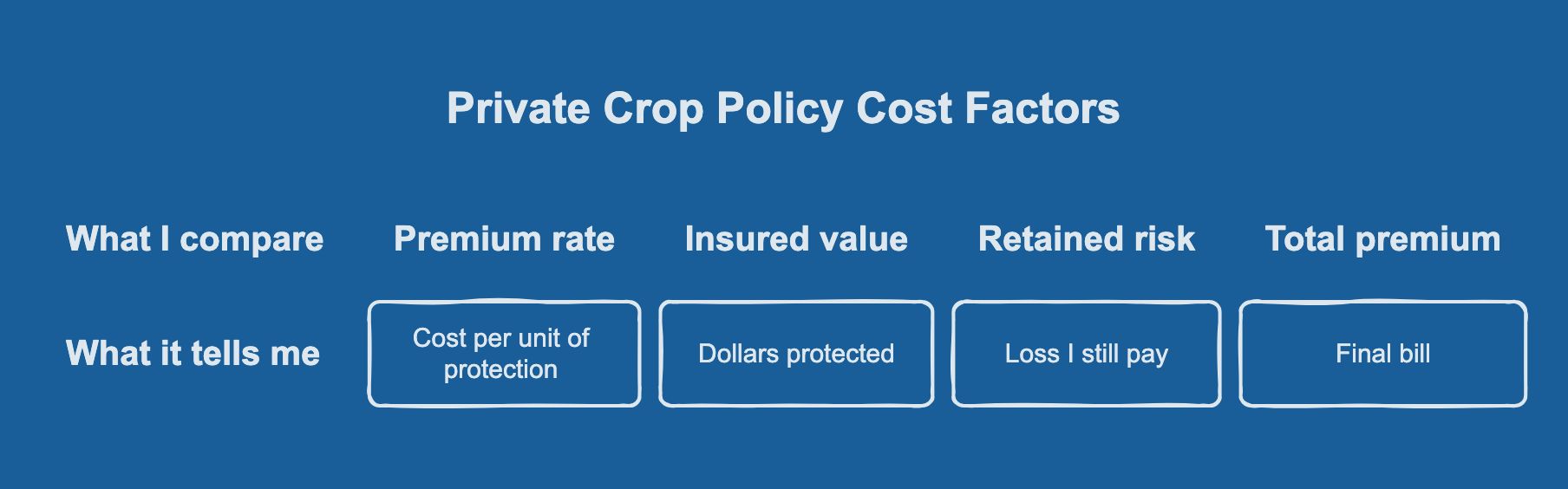
With a straight percentage deductible, 80% coverage leaves a 20% deductible, but exclusions and limits can leave additional losses unpaid. An area-based policy may pay nothing for a farm loss if its county trigger isn’t met.
My next step: request two coverage or deductible options using the same records. In Arkansas, I also confirm county and irrigation details, required underlying coverage, reporting deadlines, and payment timing before buying.
What Determines the Cost of Crop Insurance?
sbb-itb-b725090
How Factors Affect Premium Rates
Private supplemental policies set their own rating rules. USDA RMA methods offer context, not a formula that applies to every policy.
The table shows which factors increase premiums, insured value, or both.
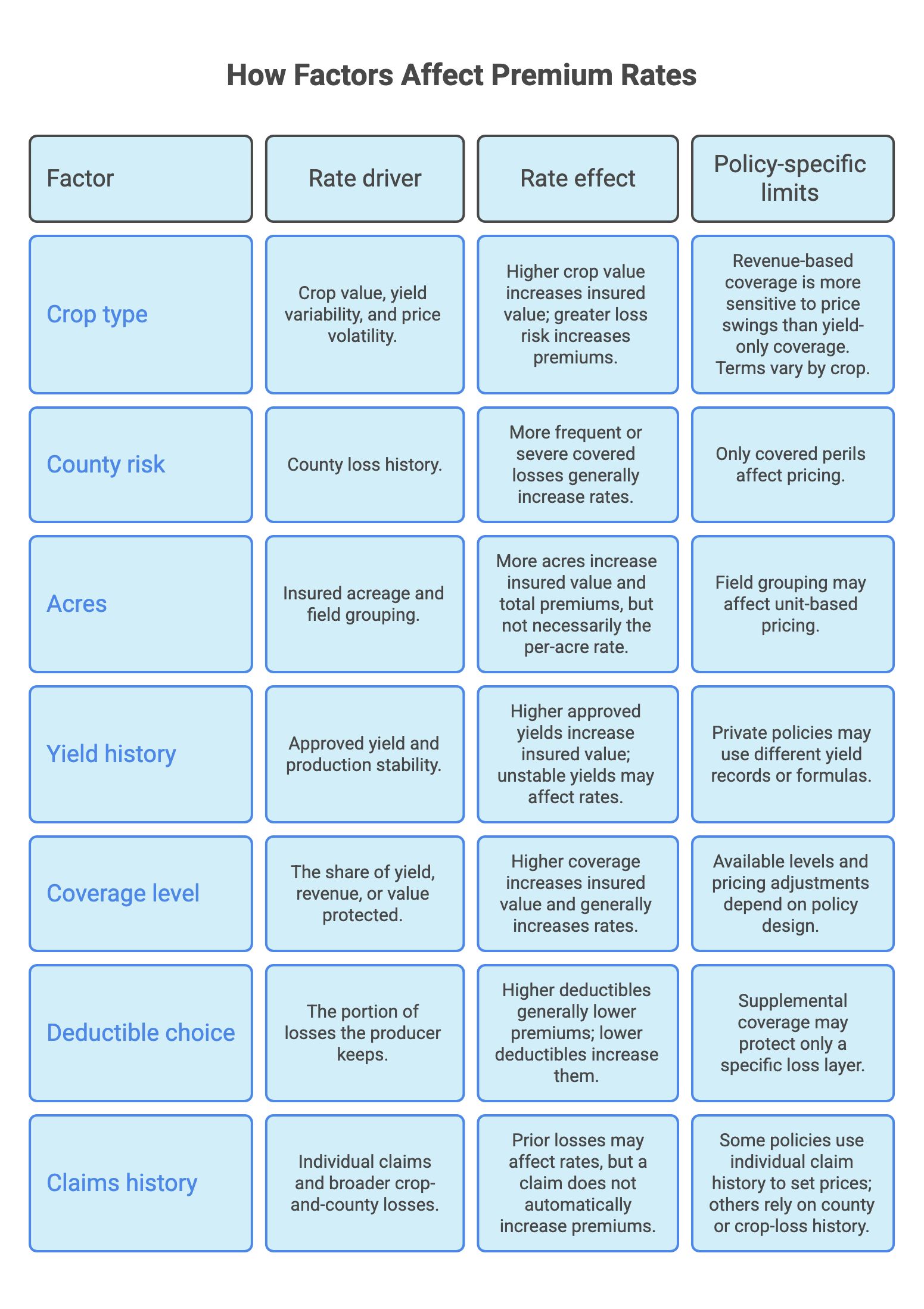
When comparing policies, look at the rate inputs alongside the payout trigger.
How Inputs Affect Insured Value
Premium rate and insured value are different. The same policy can cost more because it protects more dollars. Insured value is the estimated dollar value of the crop or production protected - not the premium. For yield- or revenue-based policies, a simple estimate is approved yield × coverage level × insured price × acres.This estimates insured value; it isn’t a universal premium formula. Some supplemental policies cover a gap left by another policy or use a per-acre limit.
The table below shows how the main inputs increase or decrease insured value.
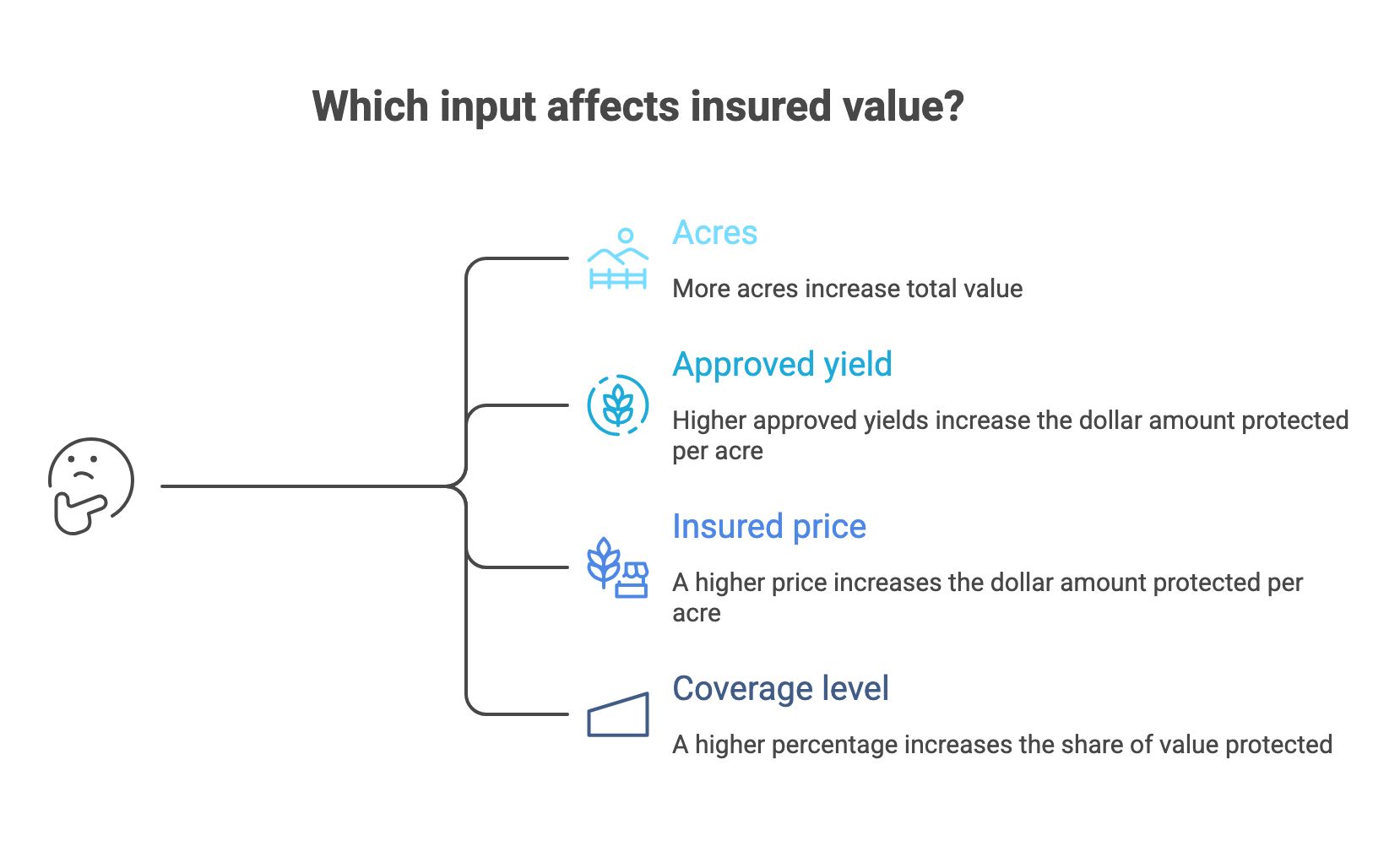
Yield-based policies depend on how the approved yield is set. Actual Production History (APH) is the documented yield history used to set that yield. Private policies may use farm or area yields, so the policy wording controls.
Farm yields reflect the producer’s documented production. Area yields reflect county or regional production. With area-based coverage, a farm loss may not qualify for payment if the area trigger isn’t met.
1. Crop Type
Premium Rate
Crop type affects the likelihood and size of losses - but only for causes the policy covers. Compare quotes for the same crop, county, practice, coverage term, and covered causes. A lower quote may mean less protection.
Insured Value
Crops with higher values or yields can cost more to insure, even on the same acreage. Compare insured dollars per acre and total liability, not just the rate.
Retained Risk
Yield-only coverage can leave you exposed to falling prices. A revenue supplement may cover that gap, but losses tied to quality, prevented planting, replanting, and other market losses outside the policy may remain uninsured.
Ask for payout illustrations at several loss levels. Each should show the unpaid loss per acre after deductibles, limits, and any payment from underlying coverage.When a policy pays matters as much as what it costs.
Quote Documentation
Crop and practice details affect your quote. Provide the exact crop, county, acres, variety, planting date, irrigation status, intended use, and production practice. Include field-level yield records, production contracts, sales tickets, and settlement sheets.
Use the full crop and practice description - not just the common crop name.These details feed directly into crop pricing, yield history, and county-risk ratings.
2. County Risk
County risk affects your rate. It can also affect how some policies set trigger values and payment areas.
Premium Rate
In Arkansas, irrigation can reduce drought exposure, while low-lying fields may face excess-moisture risk.
County loss history and local weather patterns drive the rate. Better drainage or irrigation may help, but neither guarantees a lower premium.
Insured Value
County risk can increase the cost of insuring the same value, but it does not change your coverage amount by itself. Ask which county data and farm records were used to price your quote.
Producer-Retained Risk
An area-based policy may not pay for a loss on your farm unless the county meets its payment trigger.
If your fields flood but the county does not hit its payment trigger, you may receive no area-based payment.
Quote Documentation
Provide FSA farm and tract numbers, field maps, acreage by field, drainage details, and records of your irrigation source and capacity. Separate irrigated acres from dryland acres.
Ask which county or territory, trigger area, covered perils, exclusions, and waiting period apply to the quote. Review county loss records in USDA’s AgRisk Viewer instead of relying only on the county average. These records help you compare county-based quotes side by side.
3. Acres
Unlike county risk, acres affect cost mainly through total exposure and unit structure.
Premium Rate
More acres can increase your total premium because you're insuring more. Unit structure and unit-based discounts can also change your per-acre cost.
Insured Value
Insured value increases with acreage, but it also depends on yield, insured price, coverage level, and your share of the crop. Ask for insured value per acre and total insured value to separate added protection from changes in coverage terms.
Producer-Retained Risk
Grouping more fields into a unit can combine strong and weak fields, changing whether a loss triggers a payment. You still bear the risk for uninsured acres and excluded losses.
Quote Documentation
Before the deadline, check acreage reports against planting records, leases, and crop-share agreements. Confirm field locations and unit structure. If you add acreage, request a revised declarations page or written endorsement. Use the same acreage figures for every quote.
4. Yield History
Yield history affects both the insured guarantee and what you pay for it.
Premium Rate
Yield stability and the policy’s rating method drive how yield history affects the rate. If you elect APH Yield Exclusion, that choice increases the premium rate.
Insured Value
A higher approved yield usually increases insured value per acre. That can increase your premium even when the rate stays the same. Check whether the supplemental policy uses your individual guarantee or a separate area-based value.
Producer-Retained Risk
Individual-yield coverage pays only when the insured unit’s yield falls below its guarantee. Area-based coverage pays based on county or area results, so a loss on your farm alone may not trigger payment.
Repeated low yields can also reduce your individual approved yield over time, subject to policy adjustments. Check the policy’s payment trigger rather than assuming your own yield loss qualifies.
Quote Documentation
Provide production reports along with elevator receipts, settlement sheets, or gin records. Check which yield years the quote uses, including any transitional yields, excluded years, and trend adjustments.
Label the quote’s yield basis as APH-based or area-based, and state whether it matches the underlying policy’s guarantee.
Next, coverage level determines how much of that yield history the policy insures.
5. Coverage Level
Coverage level uses the earlier yield and value inputs to determine how much is protected - and how much risk stays with you.
Premium Rate
Higher coverage generally costs more in premiums. Common coverage levels range from 50% to 85% in 5-percentage-point increments, though options vary by crop, county, and insurance services provider.For a like-for-like quote comparison, match the coverage level, covered causes, limits, and underlying coverage.
Insured Value
More coverage generally increases the insured value.Check how the private policy calculates that amount. Does it apply the coverage percentage to expected crop value, or use stated dollars per acre or a scheduled limit? Compare insured value per acre and total liability, not just the coverage percentage.
Producer-Retained Risk
If the policy uses a straight percentage deductible, 65% coverage leaves 35% retained risk; 80% leaves 20%.
Higher coverage reduces the loss you bear before payment begins. It does not mean the policy pays that percentage of every loss. Separate dollar deductibles, exclusions, sub-limits, and payment triggers can still leave some losses unpaid.
Quote Documentation
Request quotes at two coverage levels, keeping acreage, yield, price, unit structure, and covered causes the same. For each option, record the coverage percentage, per-acre and total limits, deductible, sublimits, and net premium.
Use that comparison when choosing a deductible, which determines how much loss remains unpaid.
6. Deductible Choice
Your coverage level sets how much protection you buy. Your deductible sets when that protection starts paying.
Premium Rate
Deductibles can be fixed dollar amounts, percentages, or attachment points. Each structure affects your premium. Get quotes for at least two deductible options instead of assuming a set discount.
Insured Value
A deductible doesn’t change the insured amount - it changes when payment starts. With a percentage deductible, check what the percentage applies to: insured value, liability, yield, or revenue.
The percentage alone won’t tell you how much you could pay out of pocket. A deductible is a payment threshold, not a coverage amount.
Producer-Retained Risk
Check whether you pay the first loss amount or share each covered loss proportionally. Also confirm whether the deductible applies per acre, unit, occurrence, claim, or policy period.
Weigh the premium savings against the cash you have available to cover a loss. Use the quote to check whether the portion you retain fits your budget.
Quote Documentation
Request a written quote and specimen policy that show the deductible basis, payment threshold, formula, limit, exclusions, and reporting deadline. Match these terms across quotes so you can compare premiums accurately.
Ask the agent to calculate your out-of-pocket costs for moderate and severe losses under each option. When reviewing a lower premium, check that you can afford the loss you’d retain.
7. Claims History
Premium Rate
After considering crop, county, acreage, yield, coverage, and deductible choices, insurers may review claims history. Your claims record and county loss history are separate inputs. You might have no claims yet farm in a county with frequent losses.
Private insurers may consider how often losses occur, how severe they are, and what causes them. Ask how they treat countywide drought losses compared with recurring losses in specific fields. A claim does not automatically increase your premium.
Insured Value
Past losses generally don’t change the number of acres insured. But they can affect the yield or revenue history used to set your guarantee. Ask which yield assumptions the insurer uses in your private supplemental quote.
Producer-Retained Risk
Repeated losses may lead insurers to ask more questions about eligibility, limits, or deductible choices. Ask whether your claims record changes any of these terms. A coverage restriction can leave your farm carrying more of the loss, even when the premium stays low.
Quote Documentation
Provide at least five years of loss records. Include the crop year, crop and practice, county or field, acres affected, cause reported to the insurer, loss amount, paid amount, and claim outcome. Also include dated records of changes made to reduce losses and the production that followed.
Request the insurer’s look-back period and ask how it treats open, denied, withdrawn, or partially paid claims. Get a written explanation of any claims-based pricing adjustment.
Use the same loss records for each quote so you can compare how insurers price repeat losses and handle renewal terms.
Coverage and Deductible Trade-Offs
Higher vs. Lower Coverage
Coverage trade-offs come down to how much extra premium you pay and how much less risk you keep. Compare policies using the same crop, acreage, yield basis, price assumptions, deductible method, exclusions, and limits. Weigh the extra premium against the extra protection it buys.
Lower vs. Higher Deductibles
Deductibles set where protection starts. Check whether the deductible is a dollar amount, percentage, or threshold - and whether it applies per acre, unit, occurrence, claim, or policy period. A lower deductible covers more of the first layer of loss, but it does not change the trigger.
Compare the loss you would retain with the cash left after rent, seed, fertilizer, labor, equipment payments, interest, and family living expenses. Premium savings matter only if you can absorb the larger loss. Count unused operating credit, too, but check whether borrowing would leave enough credit to finance next season’s crop.
Payment Triggers and Coverage Limits
Coverage amounts tell only part of the story. You also need to know when the policy pays. Supplemental protection starts at its attachment point, but payment still depends on the trigger. Farm-level triggers use eligible farm results. Area triggers use county or broader area results. A loss on your farm alone may produce no area-based payment if the area stays above its trigger. Before counting on proceeds, confirm the measurement period, data source, reporting date, and expected payment timing.
Calculate how much loss falls below the attachment point, above the limit, or outside coverage. Review per-acre caps, crop sublimits, waiting periods, and restrictions on quality losses, prevented planting, or price changes. For supplemental coverage, check the required underlying coverage, offsets, and any gap between policies. Compare the combined premium and maximum combined payment, not either policy’s headline percentage alone.
Records for Comparing Quotes
Use the same record set for every quote so prices reflect the same acres, yields, and coverage terms across all seven cost factors.
Crop, Acreage, and Yield Records
Build a crop-by-crop quote file with FSA-578 acreage reports, field maps, planting and rotation records, and certified production records. Include crop type and variety, field locations, planted and eligible acres, ownership or share arrangements, planting dates, farming practices, irrigation status, and rotation history.
Confirm which yield years and any transitional yields each quote uses.Using these records across quotes lets you compare the seven pricing factors on the same basis.
Claims Records and Coverage Choices
Note which documents the insurer uses. Organize claims by crop, county, year, cause of loss, acres affected, amount claimed, and amount paid. Include denied or withdrawn claims, plus dated records of drainage, irrigation, or other practice changes. Record any effect on underwriting or eligibility.
Attach existing declarations pages, schedules, endorsements, limits, deductibles, exclusions, renewal terms, and supplemental private policy records. Note each selected coverage level, insured price, deductible, and policy period so you can spot overlaps or gaps.
Use the same claim file for every quote when comparing claims-based pricing adjustments.
Premiums and Policy Terms to Check
Where possible, request quotes with matching acres, yield assumptions, insured prices, coverage levels, deductibles, and policy periods. Record these details side by side:
- Cost: Total producer-paid premium, fees, and whether pricing is based on acres or insured value.
- Insured value: Per-acre and total amounts. When insured values differ, also record the premium as a percentage of insured value.
- Per-acre premium: Producer-paid premium divided by insured acres, with the acreage used clearly identified.
- Policy terms: Coverage level, deductible amount and basis, trigger type, limits, exclusions, and policy period.
Compare premium, trigger, limits, exclusions, and payment timing together. Note covered causes, waiting and reporting requirements, sublimits, and how each policy coordinates with existing coverage.
Conclusion: Compare Cost and Protection
Compare premium rate, insured value, and retained risk together. Base your final choice on total protection and how much loss you can absorb - not price alone. A lower quote may mean less insured value or policy terms that leave you paying more of the loss.
Before buying, compare quotes using the same crop, acres, yield, price, coverage, deductible, and policy period. Ask how your county, crop, irrigation, and loss history affect eligibility, pricing, exclusions, and triggers. With area-based coverage, confirm the county trigger before counting on a payment.
For local help in Arkansas, Martin Agency farm and poultry insurance in Pocahontas offers personalized farm insurance guidance. Check directly whether a supplemental private crop policy is available for your crop, county, and coverage period.
FAQs
How can I tell if extra coverage is worth the premium?
Start with your farm’s risks. Do your yields follow county averages, or does your farm face challenges that call for farm-level protection? Weigh the financial impact of a potential loss against the premium. A higher deductible can lower your premium payments, but you’ll take on more out-of-pocket risk.
An agent at Martin Agency can help spot coverage gaps and match your plan to your farm’s revenue streams.
How much cash should I reserve for my deductible?
Weigh your monthly premium against your out-of-pocket costs if you file a claim. A higher deductible can lower your monthly payments, but you’ll pay more yourself after a loss. Consider your farm’s total value, how much risk you’re comfortable taking, and how specific events could affect your finances.
Work with your Martin Agency agent to review coverage limits and deductible options that fit your financial needs.
Could my supplemental policy leave gaps in coverage?
Yes, especially if your policy doesn’t match how your farm runs. County-based policies can leave gaps: your farm may suffer a loss, but county results might not trigger a payout. Strict planting deadlines, reporting requirements, and exclusions for risks like feed contamination can also leave you without coverage.
Martin Agency can review your coverage, spot potential gaps, and help coordinate protection that fits your farm’s needs.