If I had to boil this down to one line, it’s this: choose farm-level coverage if your own fields often perform differently than the county, and choose county-based coverage only if your farm usually moves with county results.
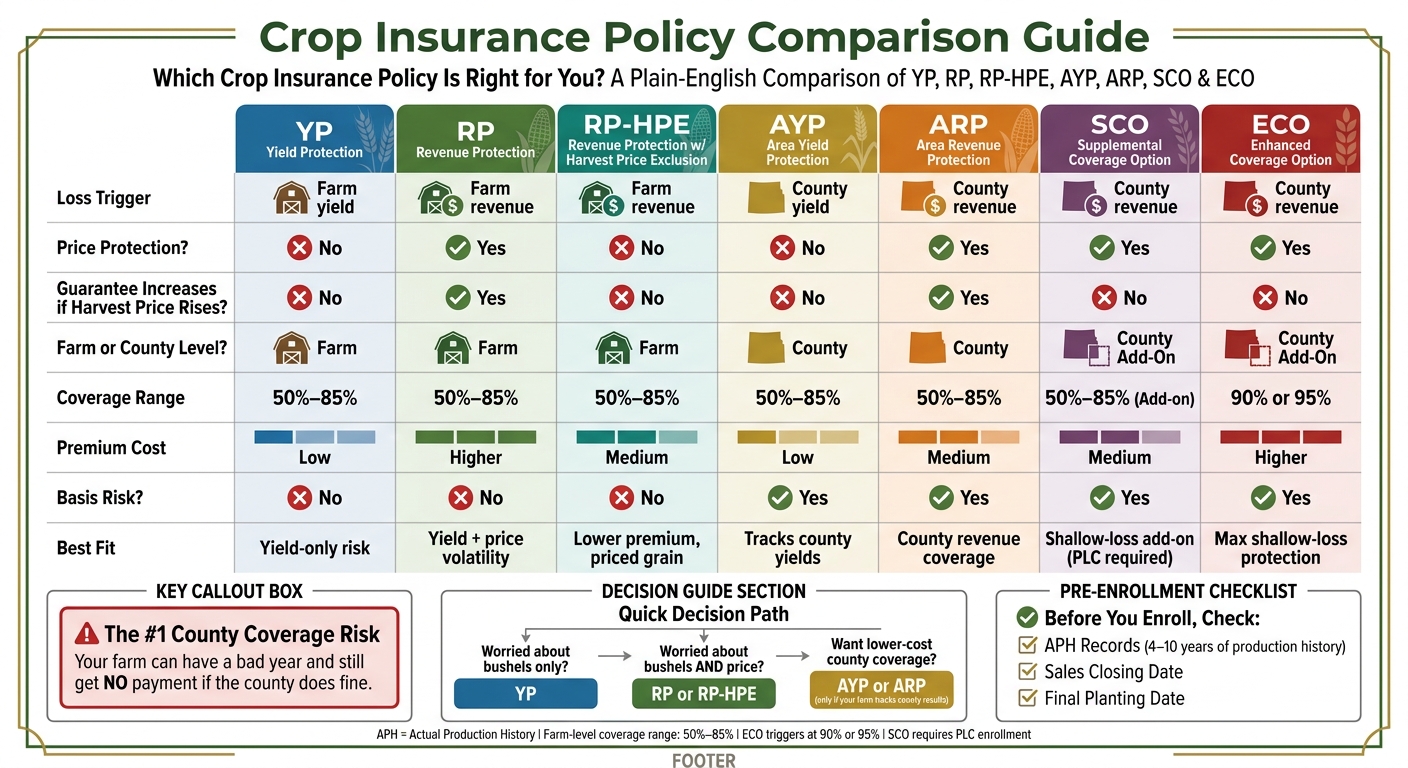
Here’s the short version in plain English:
Put another way: if you worry most about bushels, start with YP. If you worry about bushels and price, look at RP. If you want a lower premium than RP and can give up harvest-price upside, RP-HPE may fit. If you want lower-cost county coverage, AYP or ARP may work, but only if county performance matches your farm often enough.
The biggest risk in county-based insurance is simple: your farm can have a bad year and still get no payment if the county does fine.
Which Crop Insurance Policy is Right for You?
Before enrolling, I’d focus on three checks first:
That’s because the best-looking policy on paper can still miss the mark if your records, deadlines, or county fit are off, or if you need to compare poultry and general farm insurance for your specific operation.
sbb-itb-b725090
1. Yield Protection (YP)
Yield Protection (YP) pays when your actual harvested yield, plus any appraised yield, drops below your preseason yield guarantee. Put simply, YP is about bushels, not market moves.
Loss Trigger
Your yield guarantee is based on your APH yield multiplied by the coverage level you choose. Coverage levels range from 50% to 85%, and APH usually draws from 4 to 10 years of production history.
Drought and Flood Response
YP responds to drought, flood, and other natural perils, but only when those events reduce production.
Price Protection
YP covers production loss only. It uses a projected price set by the USDA Risk Management Agency (RMA) before the season starts. It does not protect you if prices shift during the growing season or at harvest.
Coverage Fit
YP is a good match for producers who care most about yield loss and less about price swings. Here’s the quick comparison.
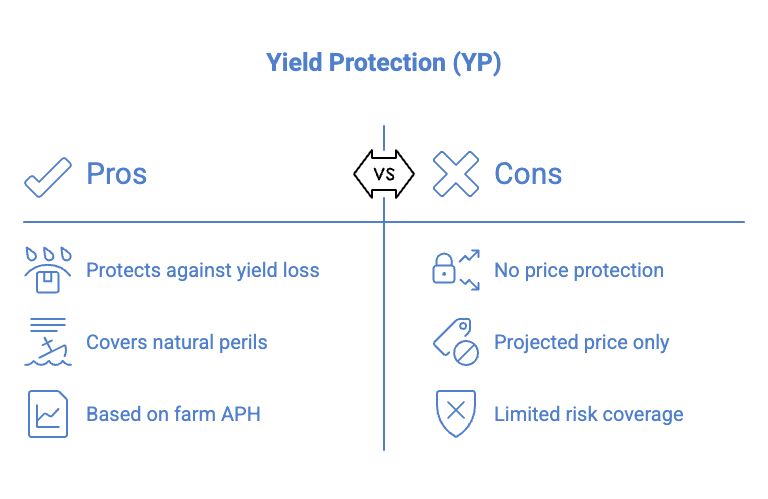
The key difference between YP and RP is that RP adds price protection; YP does not.
2. Revenue Protection (RP)
Revenue Protection (RP) covers both yield loss and price swings. That makes it a good fit for farms that need help on both sides of the equation.
Loss Trigger
RP uses the same farm-level yield base as YP, but it adds price protection on top. A claim starts when your actual revenue - harvested yield × harvest price - drops below your revenue guarantee.
Here’s the big difference: RP’s revenue guarantee can go up if the harvest price ends up higher than the projected price set before planting.
Drought and Flood Response
Drought, flood, and excess moisture can all cut harvested yield and trigger an RP claim. If harvest prices climb after a short crop, RP can increase the indemnity by using the higher harvest price instead of the projected price set before planting.
That price adjustment is the main reason RP tends to do better than YP in volatile years. Even so, RP doesn’t cover every loss once the guarantee limit is hit.
Price Protection
RP uses whichever price is higher - the projected price or the harvest price - to calculate your indemnity. That matters a lot for farms that forward-contract grain. If prices jump by harvest, that higher price can still show up in the payout.
Coverage Fit
RP is a strong choice for farms dealing with both production risk and price uncertainty, especially those that forward-contract grain.
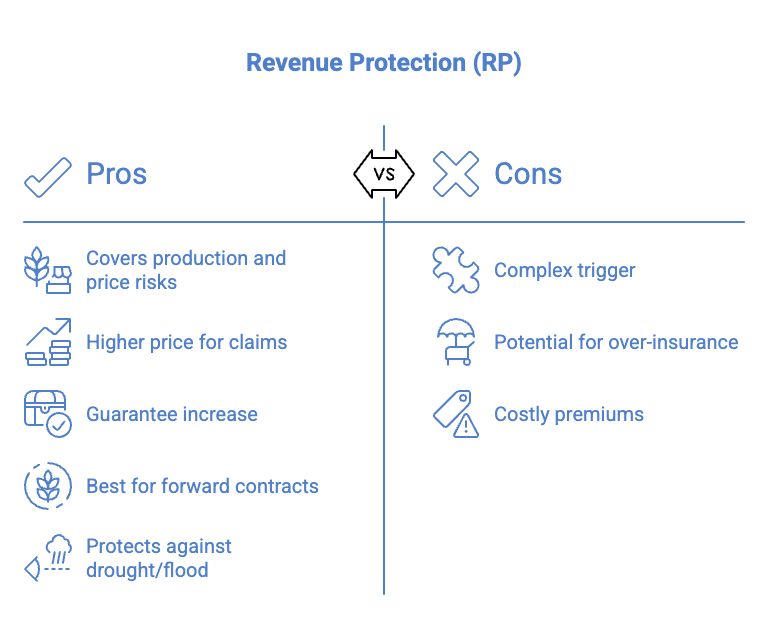
RP-HPE removes that harvest-price increase.
3. Revenue Protection with Harvest Price Exclusion (RP-HPE)
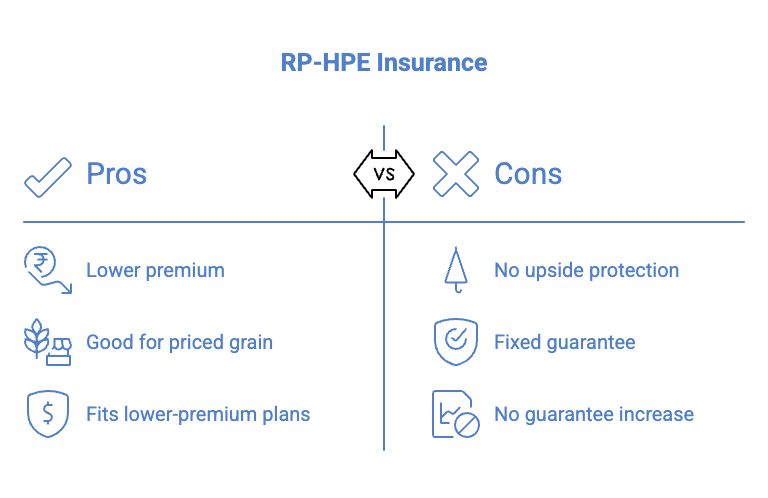
RP-HPE looks a lot like standard RP, but one piece is missing: the harvest-price increase.
Here’s the plain-English version. RP-HPE gives farms revenue protection without a higher guarantee when prices jump by harvest. The revenue guarantee is locked at the projected price set before planting, and it stays fixed no matter what happens later in the season. That’s why the loss trigger and price treatment matter so much here.
Loss Trigger
A claim kicks in when actual revenue, calculated as yield × harvest price, falls below that fixed revenue guarantee.
Put another way: a claim starts when actual revenue falls below the fixed guarantee.
Drought and Flood Response
The main tradeoff with RP-HPE is simple: it does not increase the guarantee when harvest prices go up.
That can matter in a drought or flood year. When yields drop, harvest prices may climb because supply is short. In 2012, for example, harvest prices rose sharply, and standard RP paid more than RP-HPE.
Price Protection
RP-HPE still covers price declines.
If the harvest price falls below the projected price, that lower price is used in the revenue calculation. But if prices rise, the guarantee does not move up with them. For many farms, that tradeoff comes down to two things: premium cost and price-lock strategy.
Coverage Fit
RP-HPE usually costs less than standard RP because the insurer is not taking on the risk of a higher guarantee in a high-price year.
That lower premium can be a good match for farmers who have already locked in prices through forward contracts or hedging. It can also fit farms that want lower premiums and don’t need protection for upside price moves.
4. Area Yield Protection (AYP)
AYP is the first county-based option. That means you give up some farm-level precision in exchange for lower-cost protection. Put simply, a payment happens only when the county average yield drops below the trigger, not when one of your own fields gets hit.
Loss Trigger
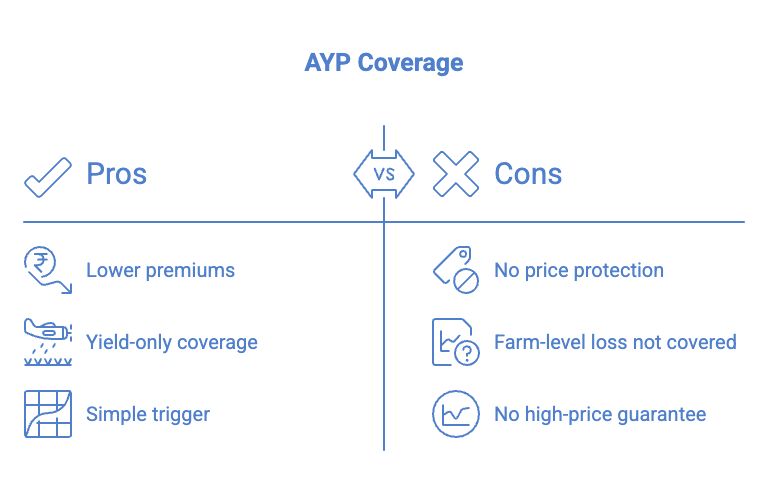
AYP pays only when county average yield falls below the trigger. So yes, your farm can take a loss and still get no indemnity. The flip side is also true: county losses can trigger a payment even if your farm had a good year.
Drought and Flood Response
AYP works best when losses hit a big share of the county. If drought or flooding is limited to a smaller area, the policy may not trigger a payment.
Coverage Fit
AYP does not include price protection. Premiums are usually lower because the policy is based on county results, not your own farm records. That makes it a solid fit for farms that follow county yield patterns and want lower-cost, yield-only coverage. ARP uses that same county trigger, but adds revenue protection.
5. Area Revenue Protection (ARP)
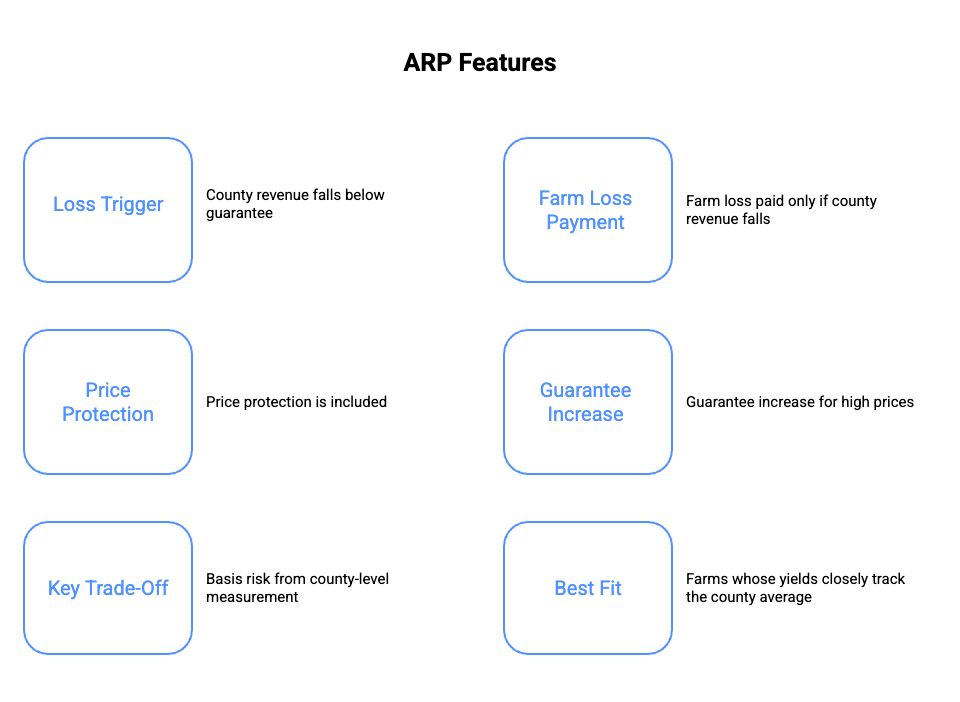
ARP builds on AYP by adding revenue protection. It’s the county-based version of RP. That means it covers yield loss and price drops, but it only pays when county revenue falls below the trigger.
Loss Trigger
ARP pays when county revenue falls below the guarantee. So there’s basis risk here. Your farm can take a hit and still get no payment if county revenue stays above the trigger.
Drought and Flood Response
ARP tends to work best in broad drought or flood years. Why? Because in those years, county revenue is more likely to drop low enough to trigger a payment. And if harvest prices go up, the guarantee goes up too.
Coverage Fit
ARP is a good match for farms whose yields tend to move in line with county averages. The main trade-off is simple: basis risk.
SCO and ECO can add another layer for farms that want extra shallow-loss coverage.
6. Supplemental Coverage Option (SCO) and Enhanced Coverage Option (ECO)
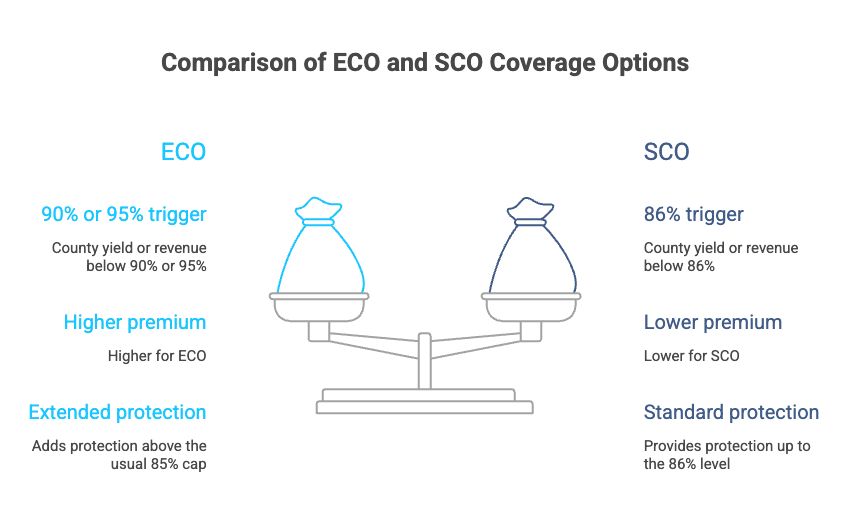
SCO and ECO are add-on endorsements, not standalone policies. They sit on top of an underlying crop insurance policy and give a farm extra help for shallow losses that don't hit the base-policy trigger. Put simply, they cover the space between routine base coverage and larger losses. That makes them most useful for farms that want help with losses that are too small to set off the main policy.
Loss Trigger
These endorsements reach into the shallow-loss band in a way base policies do not. SCO and ECO are area-based, which means they pay when county yield or county revenue drops below the trigger.
ECO pays when county yield or revenue falls below 90% or 95% of the expected level, based on the trigger the producer selects, and standard underlying policies are usually capped at 85% coverage.
Drought and Flood Response
SCO and ECO can respond to broad events like drought or flooding, but only when those losses are bad enough to pull the county average below the trigger. A loss on one farm alone may not lead to a payment. If drought or flood damage hits across the county, though, these endorsements can kick in.
Coverage Fit
ECO is available for 31 crops, including corn, soybeans, cotton, wheat, sorghum, and peanuts. The trade-off is simple: more shallow-loss protection means a higher premium, especially at the 90% or 95% trigger level.
This setup tends to work best for farms whose results track closely with county averages.
Coverage Provisions That Change the Comparison
Coverage details matter just as much as the trigger. They shape how much protection you have and what a claim looks like when something goes wrong.
Covered Causes of Loss
After the trigger type, the fine print starts doing the heavy lifting. These policies may cover the same broad perils, but they don't pay the same way. The main gaps come down to planting rules, replant benefits, deadlines, and reporting.
What each policy measures is the part that changes everything. And that shows up fast when planting gets pushed back or a stand has to be replanted.
Prevented Planting and Late Planting
Timing rules matter most when coverage is tied to what happens on your farm, not to county averages.
County-based policies are built around county results. So if your farm has a planting delay but the county as a whole doesn't, the policy doesn't respond the same way a farm-level plan can.
Replant Payments and Stand Loss
Replant payments are a farm-level feature. AYP and ARP don't include replant payments because they depend on county results, not damage in your own fields.
That distinction is easy to miss at first. But if a stand loss forces you to start over, it can hit cash flow at the worst time.
Reporting and Notice Deadlines
Deadlines aren't a side issue. Miss one, and a claim can be reduced or denied.
Farm-level policies call for acreage reports, loss notice, and production records. County-based policies still need acreage reports, but indemnities are based on published county data that determines the payment.
Premium Cost by Coverage Level
Cost only matters after the coverage setup matches the risk.
Farm-level coverage is built around your own results. County-based coverage is built around county outcomes. So even if two options look similar on price, they may respond in very different ways when the season goes sideways.
Pros and Cons of Each Policy Type
Once you compare these policies side by side, the big trade-off is pretty simple: precision versus premium. Farm-level policies follow what happens on your operation. County-based policies tend to cost less, but they may not line up with what your fields go through.
Farm-Level Policies: Strengths and Limits
RP tends to matter most in drought years because a higher harvest price can increase indemnities. That extra lift can make a big difference when both yield and market conditions move against you.
RP-HPE gives up that upside. If harvest prices climb, the guarantee does not rise with them. The trade-off is a lower premium.
YP is the most stripped-down option of the three. It covers yield loss only, with no price protection at all.
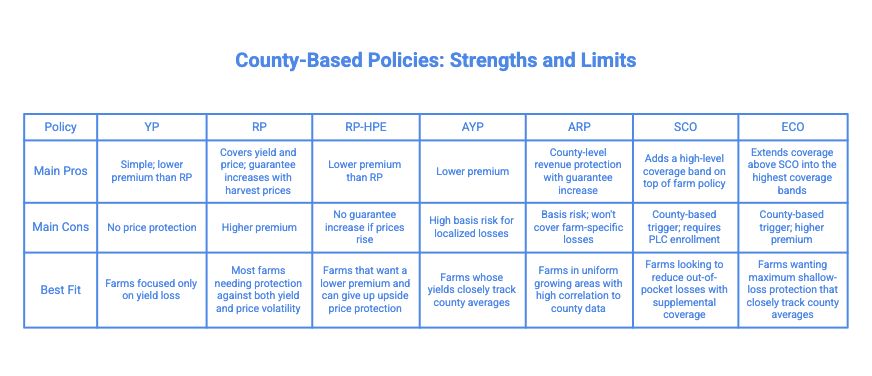
County-Based Policies: Strengths and Limits
County-based coverage can cut premium costs, but it brings more basis risk. That means your farm could get hit by a local flood or drought while the county as a whole still performs well enough that no payment is triggered. That's the main weak spot.
SCO also comes with a program rule: you must enroll in Price Loss Coverage (PLC).
Use the table below to match each policy to your risk profile.
Conclusion
RP-HPE is the lower-premium option if you want revenue protection without harvest-price upside. The main call, though, is simpler than it sounds: is your risk best measured on your farm or across the county?
Key Points for Choosing a Policy
Farm-level policies are based on your own production history. County-based products like ARP or AYP are tied to county loss patterns. That difference should guide your choice.
If your farm results often look different from the county, farm-level coverage usually makes more sense. If your yields tend to rise and fall with the county, county-based coverage may be a better fit.
Arkansas and Mid-South Considerations
That choice carries more weight in the Mid-South, where drought and excess moisture can hit one area hard and leave another mostly untouched. In places like Arkansas, county-based coverage works best only when county losses usually line up with what happens on your own acres.
What to Review Before Enrolling
Before you enroll, check these three items:
Match your coverage level to the amount of loss your operation can absorb.
Once those dates and records are in order, review the final fit with a crop insurance agent. If you farm in Arkansas or the Mid-South, Martin Agency can help review crop and poultry farm insurance options.
FAQs
How do I know if county coverage matches my farm?
Check whether the policy uses county yields or indexes to trigger guarantees and payouts. If it does, your farm’s results may not match the county’s. That creates basis risk - you could take a loss and still get no payment.
It also helps to compare your planted acreage and unit structure with the way the policy pools risk in your county. Then go over the county yield, coverage level, and deductible with your agent.
What makes RP worth the higher premium?
Revenue Protection (RP) can be worth the higher premium because it covers both yield losses and revenue drops.
Instead of only covering how much you produce, RP guarantees a set amount of revenue based on your APH yield, coverage level, and futures price. That can make it easier to sell grain before harvest, while also helping with price swings between spring and harvest.
Can I combine SCO or ECO with my base policy?
Yes. You can add ECO to SCO if you want more protection above your underlying deductible.
That said, coverage still has to follow stacking rules. And in most cases, you can’t enroll in other area products if their coverage ranges overlap with SCO or ECO.
Related Blog Posts
- 5 Essential Farm Insurance Coverage Types for Arkansas Farmers
- Farm Equipment Insurance: What Coverage Do You Need?
- How Drought Policies Help Arkansas Farmers Recover Losses
- Prevented Planting vs. Replanting: Farm Insurance
{"@context":"https://schema.org","@type":"FAQPage","mainEntity":[{"@type":"Question","name":"How do I know if county coverage matches my farm?","acceptedAnswer":{"@type":"Answer","text":"<p>Check whether the policy uses <strong>county</strong> yields or indexes to trigger guarantees and payouts. If it does, your farm’s results may not match the county’s. That creates <strong>basis risk</strong> - you could take a loss and still get no payment.</p> <p>It also helps to compare your planted acreage and unit structure with the way the policy pools risk in your county. Then go over the county yield, coverage level, and deductible with your agent.</p>"}},{"@type":"Question","name":"What makes RP worth the higher premium?","acceptedAnswer":{"@type":"Answer","text":"<p><strong>Revenue Protection (RP)</strong> can be worth the higher premium because it covers both yield losses and revenue drops.</p> <p>Instead of only covering how much you produce, RP guarantees a set amount of revenue based on your APH yield, coverage level, and futures price. That can make it easier to sell grain before harvest, while also helping with price swings between spring and harvest.</p>"}},{"@type":"Question","name":"Can I combine SCO or ECO with my base policy?","acceptedAnswer":{"@type":"Answer","text":"<p>Yes. You can add <strong>ECO</strong> to <strong>SCO</strong> if you want more protection above your underlying deductible.</p> <p>That said, coverage still has to follow <strong>stacking rules</strong>. And in most cases, you can’t enroll in other area products if their coverage ranges overlap with <strong>SCO</strong> or <strong>ECO</strong>.</p>"}}]}