If your farm gear is lost, the payout can be thousands of dollars apart based on one line in the policy: ACV or replacement cost.
I’d sum it up like this:
- ACV pays what the equipment is worth today after depreciation.
- Replacement cost pays what it costs to buy or replace similar gear today, subject to the policy terms and deductible.
- A machine that costs $15,000 to replace might pay only $7,500 under ACV if age and wear cut its value by 50%.
- With many replacement cost claims, the insurer pays ACV first, then pays the rest after you replace the item and show receipts or invoices.
- For older or backup gear, ACV may fit.
- For main tractors, combines, and precision equipment, replacement cost may help limit out-of-pocket costs.
This comes down to three things: depreciation, coverage limits, and whether the machine must be replaced fast to keep the farm running.
Quick Comparison
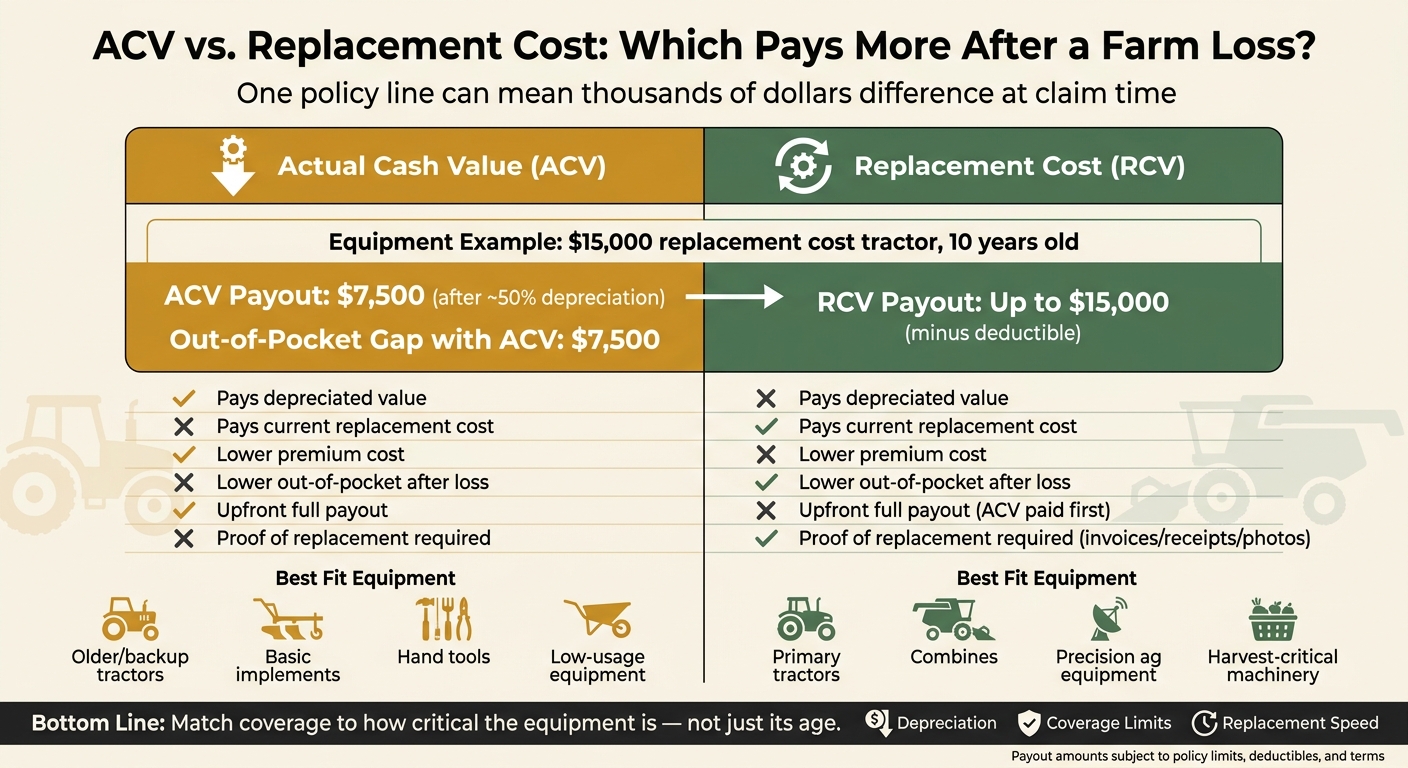
Bottom line: if you want lower premium costs, ACV may work for older equipment. If you need help getting back to the same level after a loss, replacement cost is often the stronger option.
Before choosing, I’d check the valuation method, deductible, policy limit, scheduled vs. blanket coverage, and any rule that says you must replace the item before getting the full payment.
sbb-itb-b725090
Actual Cash Value vs Replacement Cost: the core difference
These two coverages pay claims in very different ways. ACV pays what the item was worth at the time of the loss after depreciation. RCV pays what it costs to repair or replace the item with new property of like kind and quality.
That gap becomes pretty clear when a tractor, combine, or tool is totaled or damaged beyond repair.
How depreciation reduces an ACV claim
Depreciation is the difference between what an item cost when it was new and what it’s worth now. With farm equipment insurance, that drop can be steep. Insurers usually figure depreciation based on the item’s age, physical condition, and market demand.
Here’s what that can look like in plain terms: an item that would cost $15,000 to replace today might only be settled at $7,500 under ACV if it’s 10 years old. Under an ACV policy, you’d have to cover that $7,500 shortfall yourself.
So as equipment gets older, the gap between ACV and replacement cost often gets much larger.
When Replacement Cost pays more
RCV helps close that gap, but there’s a catch. In most cases, the insurer pays the ACV amount first. Then, after you repair or replace the item, it reimburses the remaining depreciation amount.
To get that extra payment, you usually need proof such as:
- Invoices
- Receipts
- Photos
You also need coverage limits that line up with current equipment prices. If your limits are too low, you can still end up underinsured even with an RCV policy.
How claim payments differ for tractors, combines, and tools
You see the split between ACV and RCV most clearly when a farm loss involves equipment that still has years of use left.
Here’s the plain-English version: ACV pays the machine’s depreciated value at the time of the loss. RCV pays what it would cost to replace that equipment today, minus the deductible. In many cases, RCV pays the ACV amount first, then pays the remaining depreciation after the item is replaced and the loss is documented.
That payment structure matters. If a claim is settled on an ACV basis, the farmer may need to pay a big out-of-pocket difference to get back to the same equipment level. And yes, the deductible still comes out either way.
Example 1: Older tractor loss
Say a 12-year-old utility tractor is destroyed in a covered loss. Under ACV, the payment would be based on its depreciated value, not the price of a similar new tractor. That can leave a pretty large gap between what the claim pays and what it takes to replace the machine.
And that gap can get even bigger when newer models come with added tech and a higher price tag.
Example 2: Combine or precision equipment loss
The math can hit even harder with combines and precision equipment. New replacements often cost far more than the depreciated value of older machines. On top of that, precision ag tech changes fast, so ACV can leave a larger out-of-pocket gap than many farm owners expect, especially when comparing poultry farm insurance vs. general farm insurance.
That gap is often the part that catches people off guard.
Which coverage option fits different types of farm gear
Once you understand how ACV and RCV work, the next step is pretty simple: match each one to the gear it makes the most sense for.
The right pick usually comes down to three things: the equipment’s age, what it’s worth, and how badly the farm needs it running.
When ACV may be the right fit
ACV often works well for equipment that’s older, less important to day-to-day work, or already getting close to the end of its service life. Think older implements, backup tractors, or hand tools grouped under one policy limit.
If a piece of equipment isn’t central to daily operations, ACV can be a reasonable choice. It can help keep premium costs lower. That said, the final payout still depends on the policy limit, so that part matters just as much as the valuation method.
When Replacement Cost may be the right fit
RCV makes more sense for equipment the farm relies on every single day. That includes a primary combine during harvest, a late-model precision planter, or a tractor that’s in constant use.
In those cases, paying more in premiums can help protect cash flow when a key machine is out of service.
RCV pays the cost to replace damaged property with new property of similar kind and quality, without depreciation.
Precision gear loses value fast and costs a lot to replace, so ACV can leave the biggest shortfall.
Comparison table: ACV vs Replacement Cost for farm gear
Use the chart below to line up each coverage option with the type of equipment it tends to fit best.

Next, review policy limits, deductibles, and settlement terms before you choose a valuation method.
What to check in a farm policy before choosing coverage
Once you see how ACV and Replacement Cost can change a claim payment, the next step is simple: read the policy terms that control the payout.
Before you choose ACV or Replacement Cost for tractors, combines, tools, and attachments, look closely at the policy language. The label on the coverage matters, but the fine print often matters more.
Key policy terms that affect claim payouts
Start by checking whether equipment is scheduled one by one or covered under a single blanket limit. Scheduled coverage makes it easier to track the payout for each item. That matters most when one tractor, one combine, or one tool group makes up a big share of the farm's value.
Next, pay attention to the valuation method for each item. This catches many farm owners off guard. Make sure you know whether each class of equipment is paid at ACV or Replacement Cost. In many policies, Replacement Cost does not apply to every machine.
Also look for replacement-first conditions, which are common in Replacement Cost claims. In many cases, RCV pays ACV first. The rest is paid only after you show proof that the item was repaired or replaced with invoices, photos, and receipts.
The coverage form type matters too. Check whether the policy uses Special Form or Broad Form. Special Form covers open perils, while Broad Form pays only for named perils.
One more thing: review the automatic coverage window for newly acquired equipment. A new tractor or attachment may need to be added fast to stay protected.
Those details can affect the claim more than the coverage name itself.
If you're not sure how your current farm policy handles these points, Martin Agency's team can review your policy.
Conclusion: balancing premium cost and coverage
ACV often comes with a lower premium, but it can leave you short after a loss. Replacement Cost costs more, but it can protect key equipment more fully.
For older backup equipment, ACV may be enough. For equipment that your planting or harvest season depends on, Replacement Cost may deserve a closer look.
FAQs
How is depreciation calculated on farm equipment?
Depreciation is figured out by estimating the equipment’s remaining useful life, then subtracting that loss in value from the replacement cost to get Actual Cash Value (ACV).
Put simply, ACV is the cost to replace the item with a similar one, minus depreciation for age, wear, and condition at the time of loss. That usually means a lower claim payout than Replacement Cost Value (RCV).
Do I have to replace the equipment before full payment?
Usually, no - you may get some money before you repair or replace the equipment. But with replacement cost coverage, many policies pay actual cash value first.
That means the insurer starts with the item’s depreciated value at the time of the loss. Then, after the repair or replacement is done, you can usually get the rest of the payment once you provide proof, such as invoices or photos. ACV only covers the depreciated value at the time of loss.
Should I use ACV or replacement cost for each machine?
Not always.
If you need enough money after a loss to fully repair or replace equipment at today’s prices, ACV may not be enough. That’s because it subtracts depreciation. So even if the machine still does the job for your business, the payout can come in lower than what it now costs to buy a comparable replacement.
Replacement cost usually pays to replace the item with one of like kind and function, without subtracting depreciation. The trade-off is simple: it usually costs more.
For older machinery or a tighter budget, ACV can make sense if you’re able to cover some out-of-pocket expense. A good way to look at it is machine by machine:
- How old is it?
- What shape is it in?
- What would it cost to replace today?
That kind of review helps you match the coverage to the equipment instead of taking a one-size-fits-all approach.