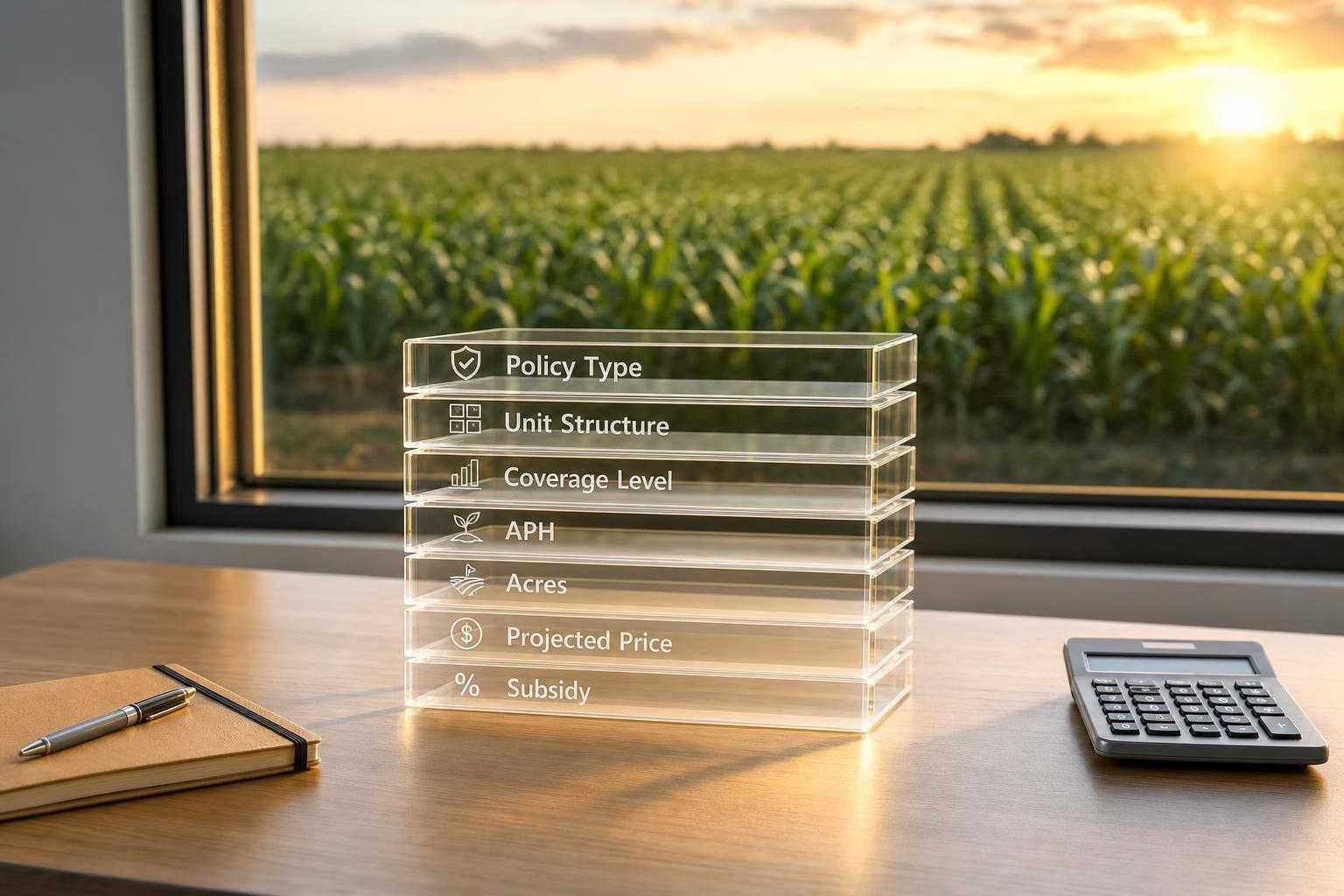
Your crop insurance bill is mostly driven by 7 inputs: policy type, unit structure, coverage level, APH, acres, projected price, and subsidy.
If I were comparing quotes, I would not stop at the producer premium. A lower bill can also mean a lower guarantee. In most cases, coverage levels run from 50% to 85%, and as coverage goes up, out-of-pocket cost usually goes up too because the deductible gets smaller and the insured amount gets larger.
Here’s the short version of what matters:
- Total premium = full policy cost before USDA help
- Producer premium = what you pay after subsidy, plus fees
- Liability = total dollar amount insured
- Indemnity = payment after a covered loss
- Higher APH, more acres, or a higher projected price usually mean a bigger premium
- Unit choice can change both premium and how losses are counted
- County rates and crop risk can make two farms with the same coverage pay different amounts
If I wanted to compare two quotes the right way, I would match these line by line:
- acres
- APH
- crop type
- county
- coverage level
- unit election
- endorsements
Bottom line: compare guarantee against guarantee, not just premium against premium. The rest of the article explains how each input changes cost and why two quotes that look close can still be built very differently.
Projected Prices Tumble: How Lower Crop Insurance Prices Impact Your Farm
sbb-itb-b725090
Crop insurance cost basics: premium, subsidy, liability, and timing
Before you compare quotes, get clear on four terms: premium, subsidy, liability, and indemnity. They shape what the policy costs, what it covers, and what you might get paid after a covered loss.
Premium vs. producer premium
The total premium is the full price of the crop insurance policy before government help kicks in. The USDA's Risk Management Agency (RMA) covers part of that price through a premium subsidy. The producer premium is what you pay out of pocket: the total premium minus the subsidy, plus any policy fees.
Liability, guarantee, deductible, and indemnity
Liability is the dollar amount your policy insures. Your guarantee shows the level of protection tied to the coverage you choose. The deductible is the share of loss you decide not to insure. An indemnity is the payment you may receive after a covered loss.
Once you know what the policy covers, the next thing to check is when the bill comes due.
When crop insurance premiums are due
Cost is only one part of the deal. Timing matters too. Premium timing follows the crop year and the policy terms, so the bill may show up later than signup. Check the policy billing schedule so you know when payment is due.
Why county rates and crop risk shape your premium
What you pay depends on more than the coverage level. County rates, crop type, and local risk conditions all play a part. That means two farmers can pick the same coverage and still pay different premiums if the county or crop risk is different.
The main choices that change your crop insurance cost
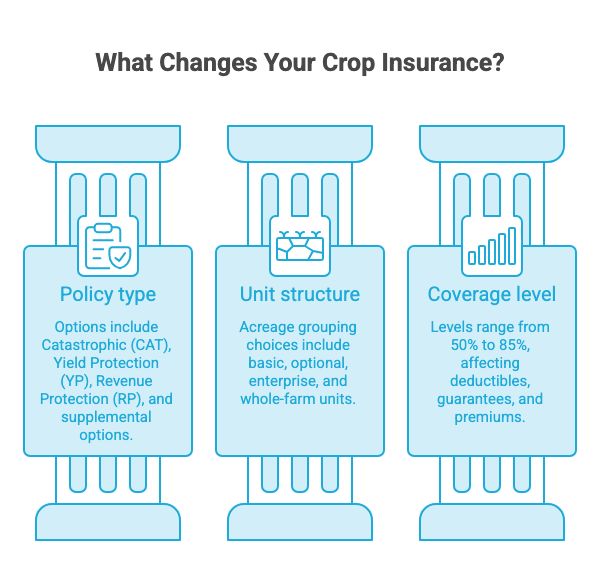
Three choices have the biggest impact on what you pay for crop insurance: policy type, unit structure, and coverage level. Each one shifts both your premium and the kind of risk your policy covers.
Policy types: CAT, YP, RP, and supplemental options
Policy type is the first big cost driver.
Catastrophic (CAT) coverage is the most basic option and is built for severe losses. Yield Protection (YP) pays for yield losses caused by insurable events. Revenue Protection (RP) adds price risk, so it can respond to price declines along with yield losses. Supplemental options can layer extra protection on top of a base policy.
Put simply, the more your policy covers, the more it can cost. A CAT policy is the bare-bones option. RP usually costs more because it covers more moving parts.
Unit structure: basic, optional, enterprise, and whole-farm
A unit is the acreage block used to figure premiums and indemnities. How your acres are grouped changes how losses are measured and can also affect the subsidy rate.
Here’s how the main unit choices work:
- Basic units group insurable acreage of the same crop within a county.
- Optional units split acreage into smaller groups.
- Enterprise units combine more acreage into one unit.
- Whole-farm coverage groups the operation under one policy.
This matters because the same farm can produce a different quote depending on how those acres are bundled.
Coverage levels from 50% to 85%
After unit structure, coverage level is the next major cost driver.
Coverage levels range from 50% to 85%. As coverage goes up, your deductible gets smaller and your guarantee gets larger. The tradeoff is simple: your out-of-pocket premium goes up too.
The goal is to pick a level that gives you enough protection without pushing the premium past what your operation can handle.
These choices show up directly in the dollar quote.
How a crop insurance quote adds up in dollars
Once the policy type, unit structure, and coverage level are set, the quote mostly comes down to APH, acres, and projected price. Those inputs shape the dollar amount of protection, and from there, the premium. Put simply: APH, acres, projected price, coverage level, and unit structure drive the final premium.
How APH, acres, and projected price affect total premium
A higher APH increases the guarantee. That pushes up liability, which also pushes up premium. The same basic math applies to acres and projected price. More acres means more insured value. A higher projected price does too.
That’s the core math behind the premium.
How subsidy changes your out-of-pocket cost
The subsidy cuts the amount billed to the producer. The subsidy percentage changes by coverage level, and lower coverage levels get a higher subsidy percentage. So if you move toward 85% coverage, the producer premium paid out of pocket usually goes up.
That’s why two policies can show the same coverage level but still leave the producer with different out-of-pocket costs.
Other factors that can change your quote
Unit structure and added endorsements can also change the quote. They affect liability, subsidy, and the final premium. If you’re comparing two quotes side by side, this is where a lot of the fine-print differences show up.
Common quote terms
- APH - Average yield history used to set the guarantee.
- Liability - Total dollar value of protection on the policy.
- Producer premium - Amount billed after subsidy is applied.
- Subsidy percentage - USDA's share of total premium, which varies by coverage level.
- Endorsements - Added options that change coverage and cost.
- Unit type - How acres are grouped for premium and indemnity calculations.
Knowing these terms before reviewing a quote makes it easier to spot where the actual differences are between two options, instead of focusing only on the bottom-line dollar figure.
Common mistakes when comparing crop insurance costs
Comparing premium without comparing protection
Even when quote terms look clear, people still make bad comparisons when the inputs don’t line up.
The biggest mistake is looking at producer premium alone. A lower out-of-pocket premium might seem like the better deal. But if the coverage level is lower, you’re paying less because you’re getting a smaller guarantee.
That’s the key point: compare the price to the guarantee it buys.
Missing differences in unit structure and subsidy
Unit structure and subsidy can change producer premium even when the policy type and coverage level are the same.
That’s where things can get tricky. Two quotes may look close at first glance, but small setup differences can shift the premium.
Skipping a line-by-line quote review
A quote review needs to be done line by line. Match:
- acres
- APH
- crop type
- county
- coverage level
- unit election
If even one input is different, the quotes are not comparable. Change one input, and the premium changes.
Conclusion: What matters most when comparing crop insurance costs
After looking at the pieces that shape a quote, the big takeaway is simple: crop insurance cost is about both price and protection. Your total cost comes from several inputs, and the amount you pay out of pocket is the producer premium after subsidy.
Policy type, unit structure, coverage level, APH, acres, and county rates all affect the final quote.
Compare guarantee against guarantee, not premium against premium.
If you want help sorting through those differences, Martin Agency can review your quote line by line. For a line-by-line review of crop insurance quotes, Martin Agency in Pocahontas, AR can help.
FAQs
How can I tell if a lower premium is worth it?
Compare the lower premium against what you’re giving up in coverage and payout. If the lower price comes from Actual Cash Value (ACV), your claim payment drops to account for depreciation. Replacement Cost Value (RCV) usually costs more, but it pays much closer to what it costs to replace the item.
You’ll also want to look at coverage limits, deductibles, exclusions, and claim filing deadlines. A policy can look cheaper at first glance, then leave you underinsured for the risks your farm actually faces.
Which unit structure makes the most sense?
The right unit structure comes down to your farm’s setup and what you want your coverage to do. Every operation is different, so there’s no one-size-fits-all option.
Take a close look at your crops, equipment, and property. Then work with an experienced agent at Martin Agency to pick a policy structure that matches your operation and keeps up as your coverage needs change.
What should I check before comparing two quotes?
Before you compare two crop insurance quotes, take a close look at the risks tied to your operation. That includes your crops, your equipment and other assets, and the financial hit your business could take if something goes wrong.
Then dig into the details of each policy. Review the terms, exclusions, coverage limits, deductibles, claim deadlines, and any restrictions, like geographic limits or operator requirements. A Martin Agency insurance specialist can also help spot coverage gaps and look at risks in your area.