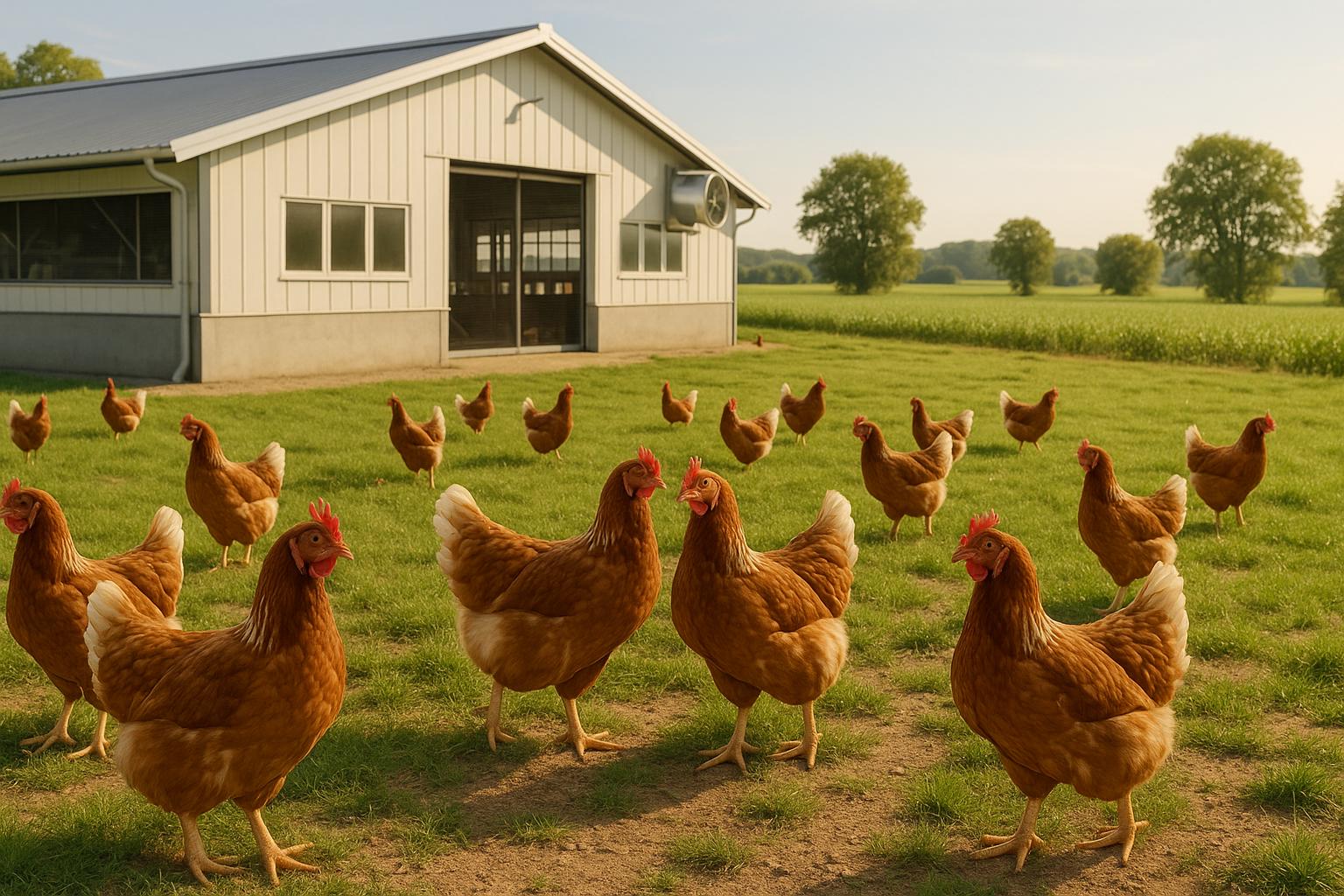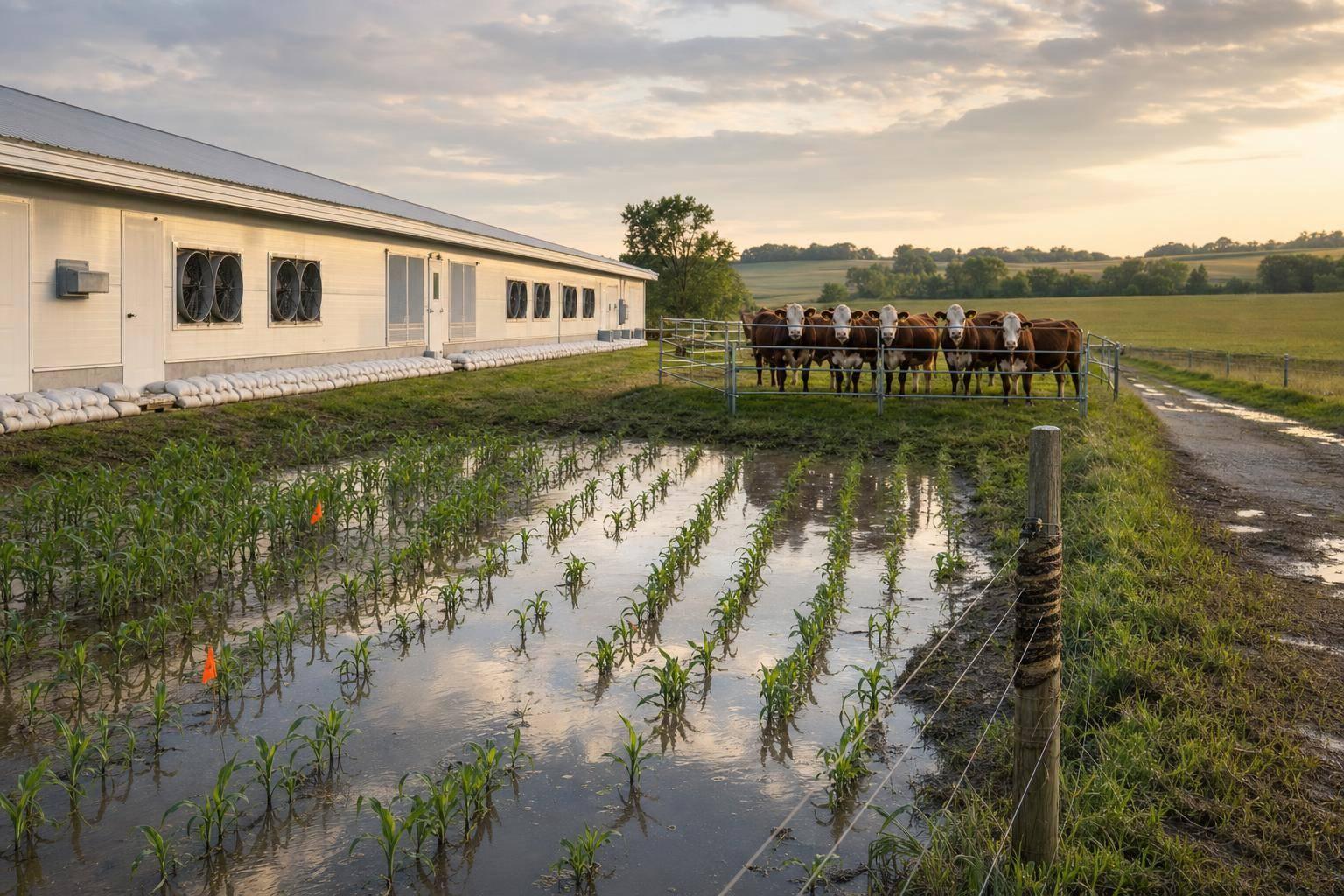
One flood can damage three farms in three different ways. For crops, the main issues are drowned plants, soil loss, and food-safety rules. For livestock, the main issues are moving animals, replacing feed and water, and fixing fences, barns, and wells. For poultry, the biggest danger is house failure: if power and ventilation stop, bird losses can climb fast.
If I had to sum up the article in a few lines, it would be this:
- Crops: If floodwater touched the edible part, the crop will often need to be destroyed.
- Livestock: Move animals before roads close, and throw out any feed that touched floodwater.
- Poultry: Check power, fans, water, litter, and air quality before anyone enters or birds return.
- All farms: Document damage before cleanup, separate contaminated feed, and report losses on time.
A few deadlines and numbers stand out:
- Insured crop losses should be reported within 72 hours of discovery, with written follow-up within 15 days
- Some vegetable fields may need a 30 to 60 day wait before replanting
- Some guidance calls for at least 60 days if waste contamination is possible
- Sediment around 6 inches or more may need extra field work before planting
- A 30-foot buffer can help reduce cross-contamination near flooded ground
- Hurricane Florence flooding in North Carolina affected poultry sites with about 1.8 million birds, and dead-bird disposal was estimated near $11 million
The big point: flood damage is not just about what water breaks. It is also about what water contaminates.
Farm Wisdom: Flood Preparation and Recovery
sbb-itb-b725090
Quick Flood Risk Comparison
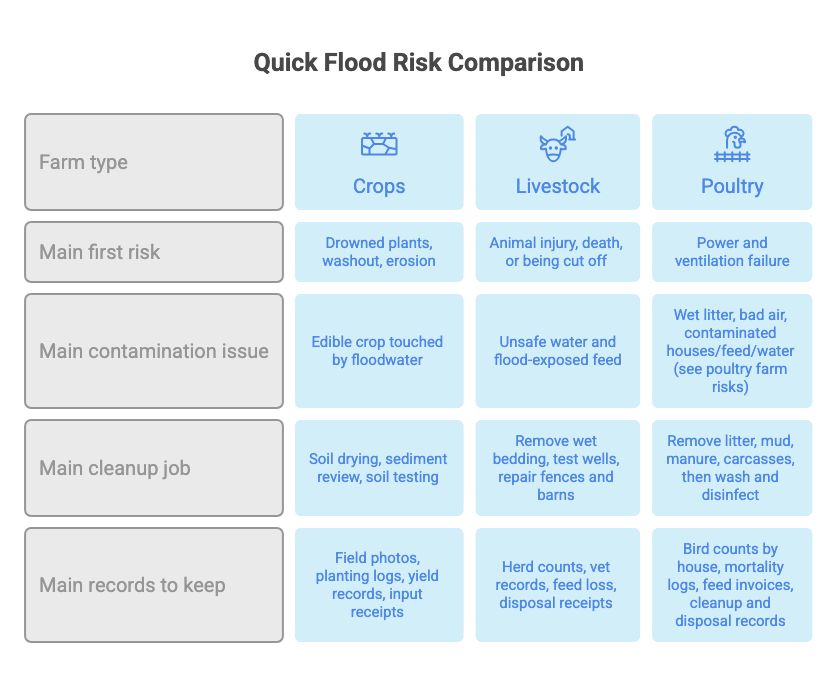
So if you are reading this after a storm, I’d keep the order simple: make the site safe, protect people and animals, separate anything contaminated, take photos, and call your insurer and USDA/FSA within the required time limits.
1. Crops
Immediate Flood Impact
Floodwater can drown plants, knock crops flat, lodge grain, strip off topsoil, bury rows under sediment, and wash away seed, fertilizer, and pesticides. When the water is moving fast, the damage is often worse because it can carry off the soil layer that does most of the work in the field. After the water pulls back, trouble can still linger. Saturated soil cuts oxygen off from roots, and heavy equipment on wet ground can compact the soil and hurt yields later on. The level of damage depends on flood depth, how long the water stayed, how fast it moved, the crop’s growth stage, and whether the water was contaminated.
Health and Contamination Risk
The big food-safety issue is simple: did floodwater touch the edible part of the crop?
If the edible portion was exposed, the crop should usually be discarded or destroyed. Floodwater can carry sewage, pathogens, chemicals, fuel, animal waste, and other contaminants. That includes crops like leafy greens, berries, tomatoes, and squash.
Timing matters too. Some farm guidance says to wait 30 to 60 days after flooding before replanting vegetables, based on the water source, crop type, and test results.If human or animal waste may be in the field, and the next crop grows in soil or is eaten raw, some guidance says to wait at least 60 days. If the field was exposed to chemicals from industrial sites or fuel spills, the delay may be longer, and cleanup may call for field-specific remediation before planting can start again.
Cleanup and Recovery Needs
Don’t rush equipment back into the field. The soil needs to dry first. Driving across wet ground can cause compaction that cuts into production for more than one season.
Sediment needs a close look before it’s worked into the soil. A thin layer may be workable, but deposits around 6 inches or more often need to be moved around first.It also helps to test soil in several spots across the flooded area. That can flag pathogens, chemical contamination, pH changes, and nutrient loss before replanting starts.
A few field-safety steps matter here:
- Keep equipment, harvest bins, and tools that touched flooded ground out of clean fields until they’ve been cleaned and sanitized.
- UMass Extension also advises a 30-foot buffer between flooded ground and crops meant for human consumption to cut down cross-contamination during field work.
Recovery usually starts with soil checks and contamination testing. After that, the next step is documentation.
Documentation and Coverage Concerns
If the crop is federally insured, report the damage within 72 hours of finding it, then follow up in writing within 15 days.You should also contact your local USDA Farm Service Agency office. Before you plow under, throw out, or sell damaged crops, get approval from your insurer or agency contact when you can. If you have to act first because of an emergency, document everything with dated photos, receipts, and a written explanation.
Coverage can come from different places, and each policy may deal with a different type of loss. Federal crop insurance, NAP, farm-property coverage, and flood coverage do not all cover the same thing. A farm insurance specialist can help sort through crop, flood, and property claims. Keep records such as planting logs, yield history, input receipts, labor invoices, repair estimates, and disposal receipts.
Livestock risk shifts from field loss to animal movement, feed protection, and fence recovery.
2. Livestock
Immediate Flood Impact
Crop losses usually stay put. Livestock losses don’t. With animals, flood risk turns into a movement and access problem fast. Rising water can drown, injure, or scatter livestock. It can also cut off barns, wells, and roads needed to move animals out safely.
Move animals before roads become impassable. If water is rising fast, trying to move a herd at the last minute can lead to drowning, panic, and vehicle crashes. When evacuation isn’t possible, move animals to the highest ground you have or into a sturdy shelter. Then secure clean water and feed and hold them there until it’s safe.
Health and Contamination Risk
Floodwater can carry sewage, waste, pathogens, fuel, and heavy metals. If livestock drink from flooded ponds, streams, or unsafe wells, the health risk is serious. Any water source exposed to floodwater should be tested before animals use it, even if the wellhead never went under.
Discard feed that was exposed to floodwater. Don’t try to save it. The FDA treats flood-exposed feed as unsafe, and drying or cleaning it does not fix the problem.Set aside any questionable hay, grain, or supplements and dispose of them under state rules and your insurer’s instructions. Keep records showing the feed was not used.
Cleanup and Recovery Needs
Before you start cleanup, check for structural damage, electrical hazards, gas leaks, and moving water. Then photograph everything before major repairs begin. Common recovery work includes removing mud and wet bedding, fixing fences and gates, draining and drying barns, cleaning and disinfecting pens, testing wells, and replacing contaminated feed and bedding.
Wet bedding needs attention right away. Remove and replace it fast to limit sanitation and animal health problems.Sick or injured animals should be isolated. Keep livestock away from standing water and flood-damaged lots, and don’t let them graze flooded forage until it has been checked. Clean and disinfect boots, trailers, and equipment before they enter clean areas.
Documentation and Coverage Concerns
Livestock flood losses often hit more than one area at once, so document each type of loss on its own. That can include animal deaths, missing animals, contaminated feed, veterinary care, fencing, wells, barns, equipment, and cleanup labor. Back up each item with dated photos, herd inventories, veterinary records, disposal receipts, and written notes that tie the cost to the flood.
Report animal deaths to your state agency and contact the USDA Farm Service Agency about the Livestock Indemnity Program.Notify your insurer as soon as you can, and when it’s safe, leave damaged property in place for inspection. Coverage changes from one policy to another, so check whether your policy pays for flood damage, livestock mortality, contaminated feed, veterinary care, fencing, wells, barns, equipment, debris removal, and business interruption. Martin Agency can help producers review flood-related coverage gaps.
Poultry losses can climb even faster because floodwater may cause ventilation failure, wet litter, and mass mortality.
3. Poultry
Immediate Flood Impact
For poultry farms, flood risk usually turns into house-system risk fast. Once power or ventilation goes down, losses can snowball. Unlike crops, where the main damage happens in the field, poultry losses often start inside the house. Flooding can kill birds, cut off access, and damage electrical and ventilation systems. It can also disrupt feed, water, heating, cooling, and backup power. On top of that, it can damage floors, litter, nest boxes, feeders, drinkers, egg-handling equipment, roads, and storage areas. If the power goes out, fans stop. That can expose birds to fast temperature stress and higher mortality.
The losses can be massive. In September 2018, Hurricane Florence flooded poultry operations in North Carolina that housed about 1.8 million birds. Dead-poultry disposal costs were estimated at about $11 million.
If birds need to be moved, use your written emergency plan and work with local officials and your state veterinarian. Pick a safe destination before transport starts. That site needs housing, feed, water, ventilation, and biosecurity controls already in place. Birds should not go back into any house until the buildings, utilities, access routes, and water supplies have been checked and cleared for use.
Health and Contamination Risk
Floodwater can contaminate houses, feed, wells, and equipment. Do not use untreated surface water for drinking or cleaning after a flood. It can spread avian influenza and other pathogens. The poultry house may look fine at first glance and still be unsafe.
Standing water near poultry houses brings another problem: it can draw in wild waterfowl and increase biosecurity risk. USDA recommends grading the property, filling low spots where water stands for more than 48 hours, and using drains or culverts to move water away from buildings.Wet litter and decomposing carcasses can also increase ammonia and other gas levels inside houses. Because of that, never enter a flooded house alone, and make sure ventilation is handled safely before cleanup starts.
Once you spot contamination, cleanup can't wait.
Cleanup and Recovery Needs
Cleanup has to happen in the right order. If mud and waste are still in place, disinfection won't do much. USDA biosecurity guidance says disinfectants do not work when they are applied over manure, feathers, mud, or other organic material.
The process should go like this:
- Remove manure, feathers, mud, and carcasses first
- Wash with detergent
- Rinse well
- Apply an EPA-registered disinfectant labeled for poultry facilities
- Let the facility dry fully before birds return
Flooded litter, manure, sludge, and carcasses can create infectious, chemical, respiratory, and confined-space hazards. Workers need full protective gear.Carcass disposal also has to follow the farm emergency plan and state rules.
Documentation and Coverage Concerns
Good records matter because losses can differ from one house or flock to another. Track losses by house so mortality, feed loss, and cleanup costs don't get mixed together. Take photos and video of damage inside and outside each building. Keep bird counts by house, mortality records, flock placement records, feed invoices, and disposal receipts.Vaccination records and payroll or contractor invoices can also help support a claim.
Coverage for poultry operations can vary a lot from one policy to the next. It's worth asking your insurer if your policy covers:
- Flood damage to poultry structures and equipment
- Bird mortality
- Contaminated feed
- Carcass and debris removal
- Equipment breakdown
- Business interruption
- Temporary relocation
Flood insurance and farm or poultry policies often cover different types of loss, so one policy may leave gaps. Martin Agency can help producers review poultry coverage before storm season.
Pros and Cons by Farm Type Under Flood Conditions
Flood recovery doesn’t look the same on every farm. Poultry farm insurance vs. general farm insurance needs differ because crops, livestock, and poultry each have their own weak spots, and that changes what recovery looks like in practice.
The biggest split comes down to how fast each farm type can bounce back. Crop recovery often happens field by field. Livestock recovery depends on whether animals can be moved and cared for somewhere safe. Poultry is the most fragile of the three, because recovery depends so heavily on whether the house systems keep working.
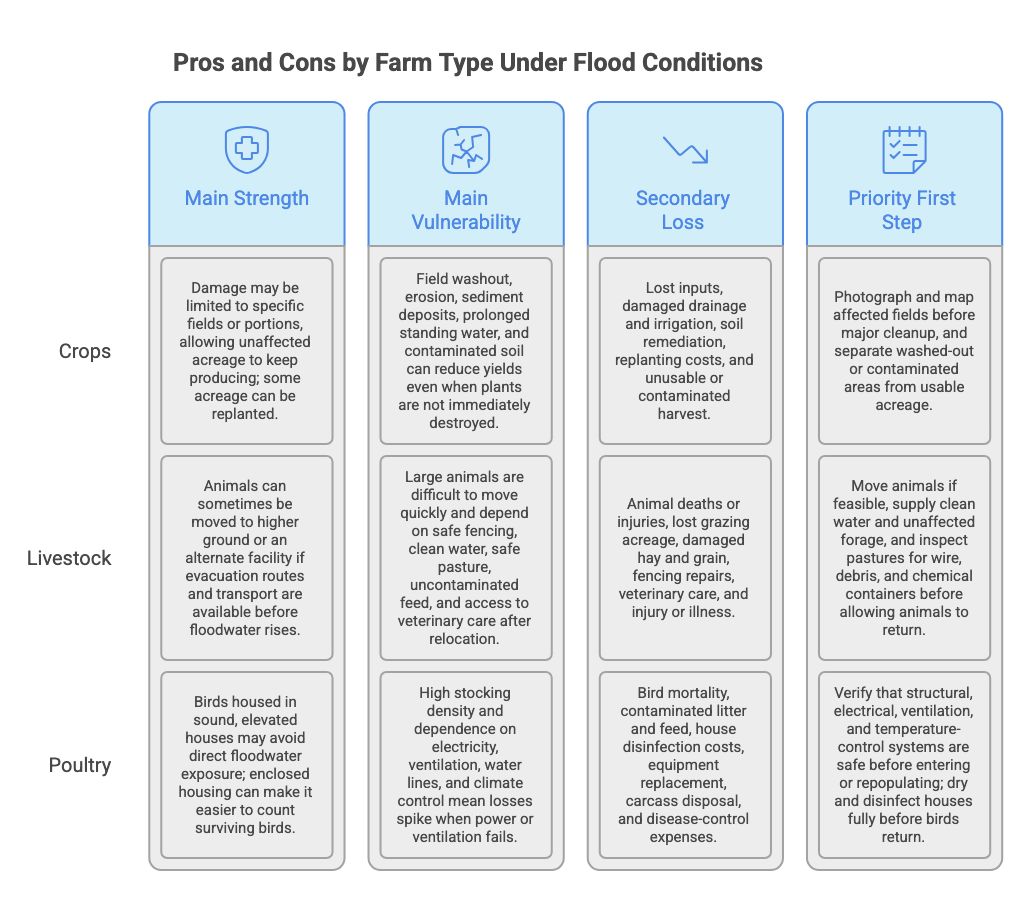
A few patterns stand out.
For crops, the upside is that flood damage is often uneven. One field may be wrecked while another still produces. That gives growers a chance to salvage part of the season or replant some acres. The hard part is that damage doesn’t stop at what you can see right away. Erosion, silt, standing water, and soil contamination can drag yields down long after the water is gone.
For livestock, timing matters more than anything else. If animals can be moved before roads close or water cuts off access, losses may drop a lot. But large animals aren’t easy to relocate on short notice. After the move, the job isn’t over. They still need clean water, safe feed, secure fencing, usable pasture, and veterinary attention before normal production can start again.
For poultry, the margin for error is much smaller. Birds may avoid direct floodwater if houses stay dry and elevated, but the whole setup depends on power, airflow, water, and temperature control. If ventilation or electricity fails, losses can climb fast. That’s why getting the building systems checked before anyone enters or restocks the house is such a big deal.
Across all three farm types, one first move stays the same: separate flood-damaged feed and document losses before cleanup.
Conclusion
Floods don't hit every farm the same way. Crops usually take the first blow in the field, livestock farms often have to move people and animals before anything else, and poultry losses can pile up the fastest. That comes down to one thing: how floodwater moves through each operation.
The same storm can lead to very different damage from one farm to the next. Flood depth, water speed, how long the water sits, contamination, and farm layout all shape the loss pattern. In simple terms, crop losses are field-based, livestock losses are movement-based, and poultry losses are system-based.
Put safety first. Keep people away from moving water, damaged buildings, and unsafe routes until utilities are shut off or cleared, structures are checked, and access points are safe.
Once the area is safe, document losses before cleanup starts. Then report them within the required deadlines to your insurer and USDA/FSA. For insured crops, report damage to your agent within 72 hours and follow up in writing within 15 days. NAP-covered crops usually require a Notice of Loss within 15 days, and livestock death losses may need to be reported to the local FSA county office within 30 calendar days, depending on the program.
To support a claim, hold on to records such as:
- Photos
- Production records
- Inventories
- Receipts
Reach out to your crop-insurance agent, farm or poultry insurance coverages, county FSA office, and state veterinarian when needed. For coverage questions, Martin Agency can help Arkansas producers review coverage details.
FAQs
What should I document first after a flood?
Document all damage before any cleanup or disposal begins. Take clear photos of affected areas, equipment, and property. If you run a poultry operation, record bird mortality counts before you dispose of carcasses.
Also, don’t change damaged acreage or throw out property before you contact your insurer or adjuster. You may need written consent first. These records help back up a verifiable loss claim.
How do I know if feed or crops are contaminated?
You may spot contamination when performance starts slipping, even if the feed looks fine at first glance. Common signs include weaker bird performance, poorer feed conversion, slower weight gain, or delays in flock timing.
Pay close attention to mycotoxins, moisture damage in bins, and feed exposure tied to a disrupted mill or supply chain. If contamination leads to illness, death, or lower productivity, document the feed’s condition and keep detailed performance records. Then review any policy exclusions or riders with your agent.
When is it safe to replant fields or return animals?
Only bring animals back after the site is safe and the recovery work is done. For poultry, bird placement is often pushed back until repairs are complete and any required inspections are approved. That process can take several weeks.
Before animals return, follow biosecurity steps. Quarantine them for 21 to 30 days before mixing them with the main herd or flock. Also sanitize facilities and equipment to help prevent disease spread after flooding.