If your farm earns money from poultry, crops, and hay, one storm can cut all three at once. I’d look past poultry farm insurance vs. general farm insurance and focus on whether a policy also pays for lost farm income during downtime.
Here’s the short version:
- Property-only insurance usually pays for things like poultry houses, barns, equipment, or stored feed after a covered loss.
- It often does not pay for lost contract income, missed flock placements, lower hay sales, or crop income lost during repair time.
- Private whole-farm coverage is built around the farm’s total revenue, so it can connect physical damage to the income hit that follows.
- That matters in places like Arkansas, where 13,637 storm events from 2015 to 2025 led to about $938.1 million in property and crop damage.
- After the January 2026 winter storm, Arkansas poultry losses were estimated at about $200 million, including about $26.83 million in lost grower income from damaged or destroyed houses.
If I were reviewing this kind of policy, I’d focus on four things first:
- Downtime risk: What happens to cash flow if houses sit empty for 3 to 6 months?
- Feed risk: Does the policy stop at feed replacement, or does it also address lower flock income from contamination or supply problems?
- Cross-farm impact: If one event hits poultry, hay, and crops, does the policy treat that as one income problem?
- Policy gaps: Are poultry, crop, hay, equipment, and liability split across plans that may not line up well at claim time?
The main point: if your farm runs as one business, your coverage should be checked the same way.
Whole Farm Revenue Protection: Myths, Mistakes, and Must-Knows
sbb-itb-b725090
Quick Poultry Farm Insurance Comparison
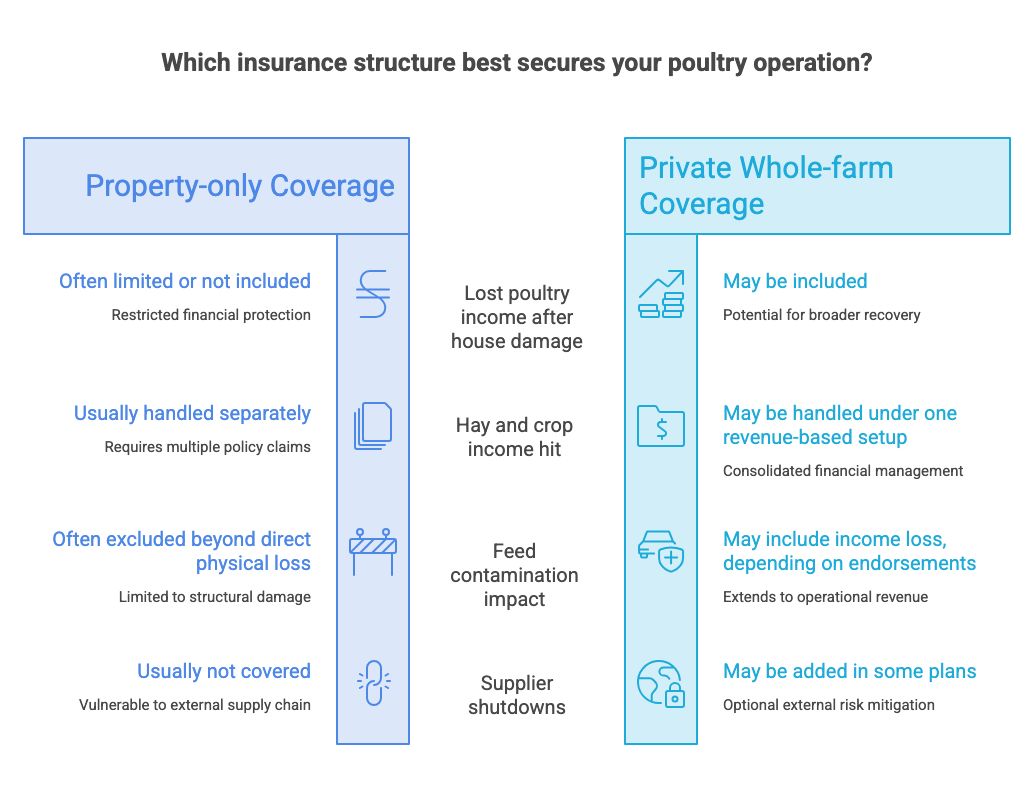
I’d use this article to compare repair coverage versus essential poultry insurance coverages, and to spot where a mixed farm can still lose money after a covered property claim. For a complete review of your policy, see our poultry farm insurance checklist.
Where Standard Coverage Can Leave Income Gaps
Income Loss After Damage to Poultry Houses, Barns, or Equipment
A property policy may pay to rebuild a damaged poultry house. What it usually does not do is replace the income you lose while that house sits empty.
After fire, wind, or hail damage, the poultry company will often stop bird placements until repairs are done and inspections are cleared. That can take weeks. In some cases, it can wipe out more than one grow-out cycle. Meanwhile, the bills keep showing up: loan payments, utilities, and labor costs don’t pause just because contract income does.
That problem is not small or theoretical. A preliminary assessment of Arkansas poultry industry damage from the January 2026 winter storm estimated $26.83 million in foregone grower income statewide from lost production capacity in damaged or destroyed poultry houses, along with a total statewide economic impact of $48.26 million in lost output.
So even when the building itself is covered, the farm can still take a hard hit on cash coming in. And on mixed farms, the strain can spread. The same storm that damages poultry houses may also slow fieldwork or hay harvest. If the same tractors, trailers, or labor crews support both sides of the operation, one loss can ripple through the whole business.
Feed Exposure, Contamination, and Supply Disruption
Feed issues can be among the costliest risks on a poultry farm, and they often happen quietly. No burned building. No broken machine. Just weaker bird performance and shrinking checks.
Mycotoxin contamination, moisture damage in bins, or a mill shutdown can hurt flock results without setting off a standard property claim. That’s part of what makes feed risk so frustrating. The damage may show up in feed conversion, weight gain, or flock timing long before it shows up anywhere else.
Research has found that contaminated crops used as feed can reduce poultry feed efficiency by up to 10%, leading to losses of more than £150,000 per year for a medium-scale poultry operation, or about $190,000+.
Standard property coverage will often pay for spoiled feed only if a covered event caused the loss. But the larger business damage usually sits outside that lane, including:
- Missed performance bonuses
- Longer grow-out periods
- Empty houses during cleanup or supply delays
On a mixed farm, feed trouble can hit from two directions at once. It can drag down poultry results and cut into grain income at the same time.
Why Separate Policies May Not Reflect One Connected Farm Business
On paper, poultry, crops, and hay may look like separate lines. In day-to-day farm life, they’re tied together. They share labor, fuel, debt, and equipment. That means one bad event in one area can squeeze the whole operation.
For farms running 5 to 6 flocks per year, a total flock loss in a single flock can cut annual gross revenue by about 16–25%, even though fixed costs stay much the same. That kind of drop can put pressure on every other part of the farm. If hay prices are weak at the same time, or a crop is still waiting in the field, cash flow can get tight fast.
Separate policies handle separate claims. They don’t look at the farm as one connected income machine. That’s the gap private whole-farm coverage is built to address.
How Private Whole-Farm Coverage Addresses Multi-Income Farm Risk
Connecting Property Damage to Lost Farm Income Across Poultry, Crops, and Hay
Private whole-farm coverage ties property damage to the farm income loss that comes right after it. That connection is a big reason it can do more for mixed poultry farms than a policy that only pays to fix buildings or replace equipment.
A private plan can be built around farm-wide business income protection based on a set revenue baseline. Insurers may use flock settlements, Schedule F income, and crop and hay receipts to set that baseline. Then the policy can state that covered damage to poultry houses, hay barns, grain bins, irrigation systems, or key equipment triggers income protection for any farm activity hit during the repair and recovery period.
Say a windstorm damages poultry houses and a hay barn in the same event. A private whole-farm plan can respond to the lost flock income during rebuilding and to hay inventory that can no longer be sold or stored the right way, instead of treating each part of the loss like it has nothing to do with the rest.
Addressing Feed-Related Losses Within a Farm-Wide Risk Plan
Feed losses often land in an awkward middle ground. The feed itself may count as inventory under a property policy. But the chain reaction after that - weaker flock performance, missed bonuses, and delayed grow-out cycles - may not appear in a basic property claim.
Private whole-farm coverage can deal with that more directly. Plans may include endorsements for product contamination, which can cover both the value of affected feed and the poultry income loss that follows if flocks are culled or delayed because the feed is unsafe. Some plans also add coverage for supplier shutdowns that stop feed deliveries. On a mixed farm, that can hit poultry results and grain income at the same time.
That same farm-wide setup also helps when a single loss would otherwise be chopped into several claims under different policies.
Coordinating Revenue, Assets, and Liability Under One Plan
When poultry, crops, and hay are all covered under separate policies, no single policy reflects the farm as a whole. One carrier may handle the poultry house, another the hay barn, and a third the liability side. If one event affects all three, the claims process can drag out and leave holes between policies.
A coordinated whole-farm plan works differently. Structures, equipment, liability protection, and income coverage sit under one framework, so the farm is handled as one business instead of a stack of separate policies. That also makes annual reviews more useful. If flock capacity grows, acreage changes, or hay markets shift, limits and endorsements can be updated together instead of piece by piece across several policies.
The next step is to compare how standard farm coverage and private whole-farm coverage respond to the same loss.
Comparison Tables: Standard Farm Coverage vs. Private Whole-Farm Coverage
The tables below show how each option handles the same loss events and where coverage gaps tend to show up for diversified poultry farms.
Table: Feed Loss Coverage vs. Feed-Related Income Protection
Feed risk makes the difference easy to see.
What hurts most isn't always the feed that gets ruined. It's what happens next when poor feed quality affects bird growth, feed conversion, or flock timing.
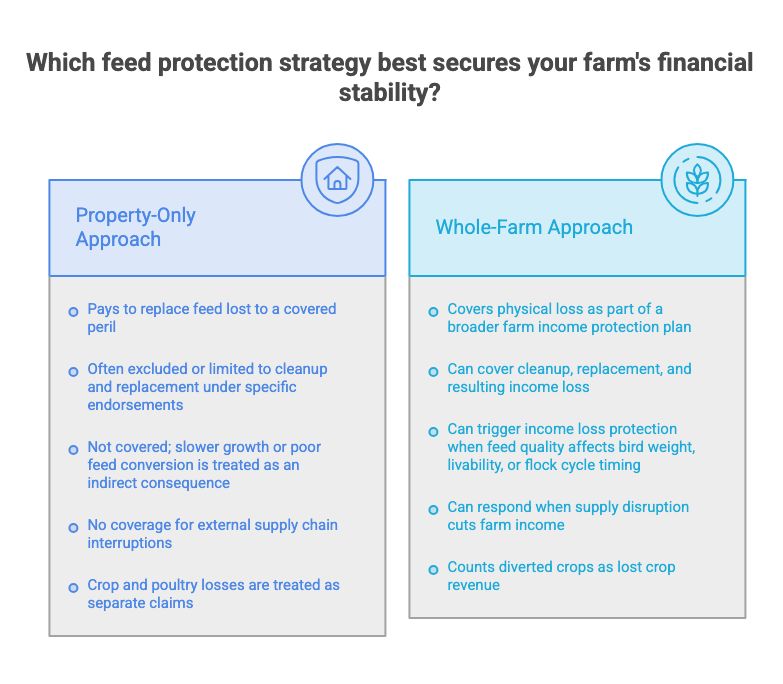
Table: Property Coverage Focus vs. Income Effect Across the Farm
The same split shows up across buildings, fields, and equipment. One policy may pay for the broken thing. The other may also account for what that breakdown does to the rest of the farm.
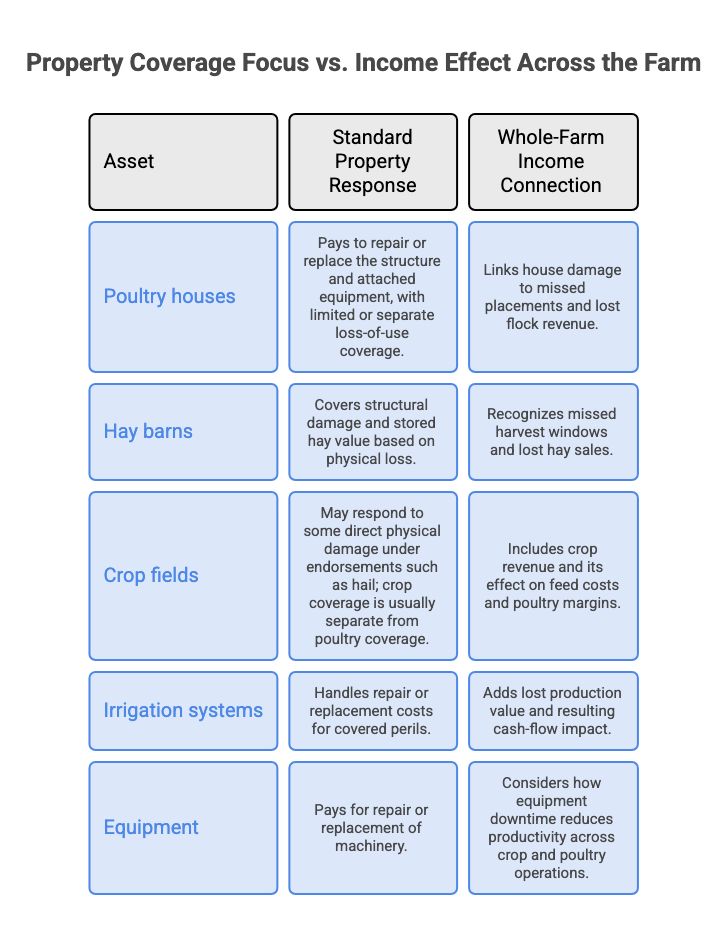
Table: Risk Coverage Tools for Diversified Poultry Farms
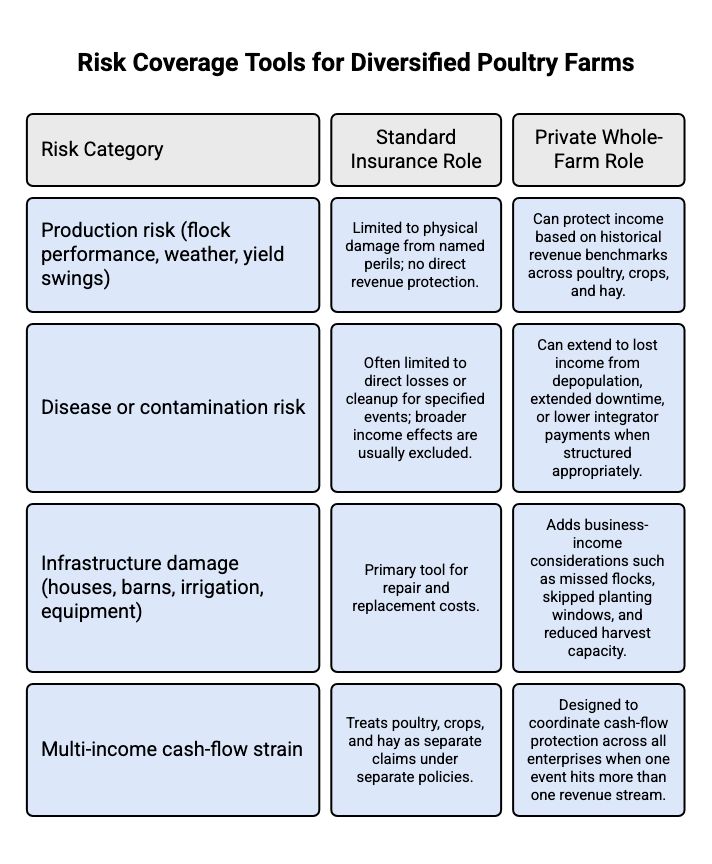
Use these tables to spot where your current policies stop at repair costs and fail to follow the loss into farm income.
Best practice: Before selecting coverage, map all interconnected revenue streams - poultry settlement checks, crop sales, and hay contracts - and identify where current policies only cover physical assets without following losses through to farm income. Reviewing past loss history, such as storms, equipment failures, or feed issues, can reveal whether prior events hurt income more than structures and help set appropriate whole-farm coverage triggers and limits.
Martin Agency can help model these scenarios against local poultry contracts and crop or hay cycles.
That gap is what the conclusion should close.
Conclusion: Building a Coverage Plan That Fits the Whole Farm
A diversified poultry farm runs as one connected business. If one part takes a hit, the damage can spread fast, cutting into poultry revenue, crops, hay, and cash flow at the same time. Standard property policies usually don’t follow that full chain of loss.
Private whole-farm coverage is built for that kind of setup. When the policy reflects the farm’s full revenue picture, it can help with lost income, not just repair bills.
Before choosing a policy, look closely at these four pressure points:
- Income-loss exposure: Map out what a 3- to 6-month shutdown would do to poultry, crops, and hay income.
- Feed-related risk: View contamination or supply disruption as an income problem, not only a feed replacement issue.
- Property-to-cash-flow connection: Link building and equipment coverage to the income those assets help produce.
- Farm-wide coordination: Look for gaps when one event affects poultry, crops, and hay all at once.
A coverage review can help show where those gaps sit in your current plan. Martin Agency, a family-owned independent insurance agency based in Pocahontas, Arkansas, works with poultry growers across Arkansas and other served states - including Missouri, Kansas, Oklahoma, Texas, and Tennessee - to review poultry farm insurance coverage and identify where whole-farm protection needs aren’t being met.
The goal is simple: coverage that matches how the farm operates and how it earns.
FAQs
How is whole-farm revenue calculated?
For coverage, whole-farm revenue is based on records that show your farm’s value and income history. In most cases, that means five years of Schedule F tax records, plus a farm production plan, marketing records, and inventory reports.
A seasoned agent can help you make sure your revenue projections and asset values match how your operation actually runs.
What losses trigger income coverage?
Income coverage kicks in when farm operations have to pause or slow down because of a covered event.
For poultry farms, that can mean lost income tied to events like:
- natural disasters
- avian influenza or other flock health issues
- supply chain disruptions
- equipment failure
- required sanitization or quarantine measures
When any of these issues interrupt day-to-day operations, income coverage helps address the revenue the farm loses during that downtime.
Do I need separate coverage for feed contamination?
Yes, you may need separate coverage or a specific rider, because feed contamination is often treated as its own risk and may be left out of a standard farm policy.
If contaminated feed makes your flock sick or leads to deaths, the financial hit can be severe. And if any affected products make it to consumers, you could also face liability claims. That’s why it’s smart to go over the exclusions with your agent and see where the gaps are.