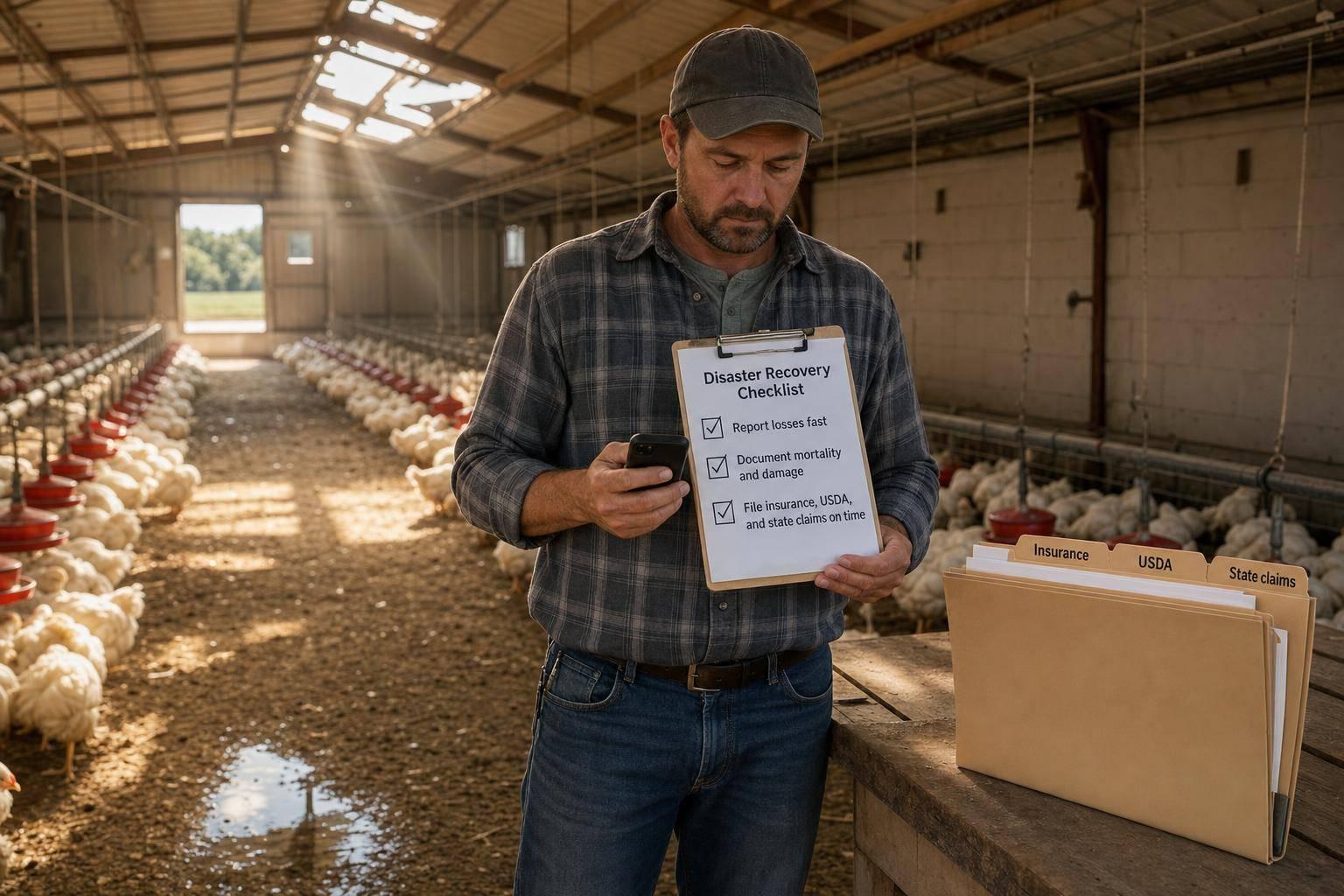
If a poultry farm gets hit by a storm, disease event, or power failure, I need to move on three tracks at once: insurance, USDA aid, and any state help that applies. The article’s main point is simple: file fast, match each loss to the right program, and keep records ready. For many poultry losses, the dates matter just as much as the damage.
Here’s the short version of what you should do:
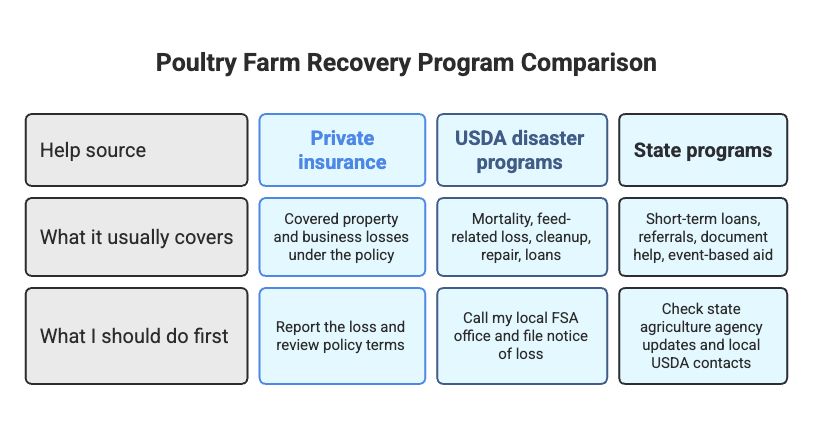
Poultry Farm Recovery Program Comparison
The article boils down to this: document damage before cleanup, call FSA early, confirm county disaster status, and submit every form by the posted deadline. That is how I give my farm the best shot at getting money moving after a loss.
sbb-itb-b725090
Federal Disaster Programs Poultry Farms Should Review First
Start with the federal programs that hit poultry losses most directly. Most of them run through the USDA Farm Service Agency (FSA). For poultry farms, timing matters a lot. FSA deadlines and loss notices can decide whether you qualify, so move as soon as the damage is clear. The best approach is simple: report losses fast and tie each loss to the right program.
Livestock Indemnity Program and ELAP for Poultry Losses
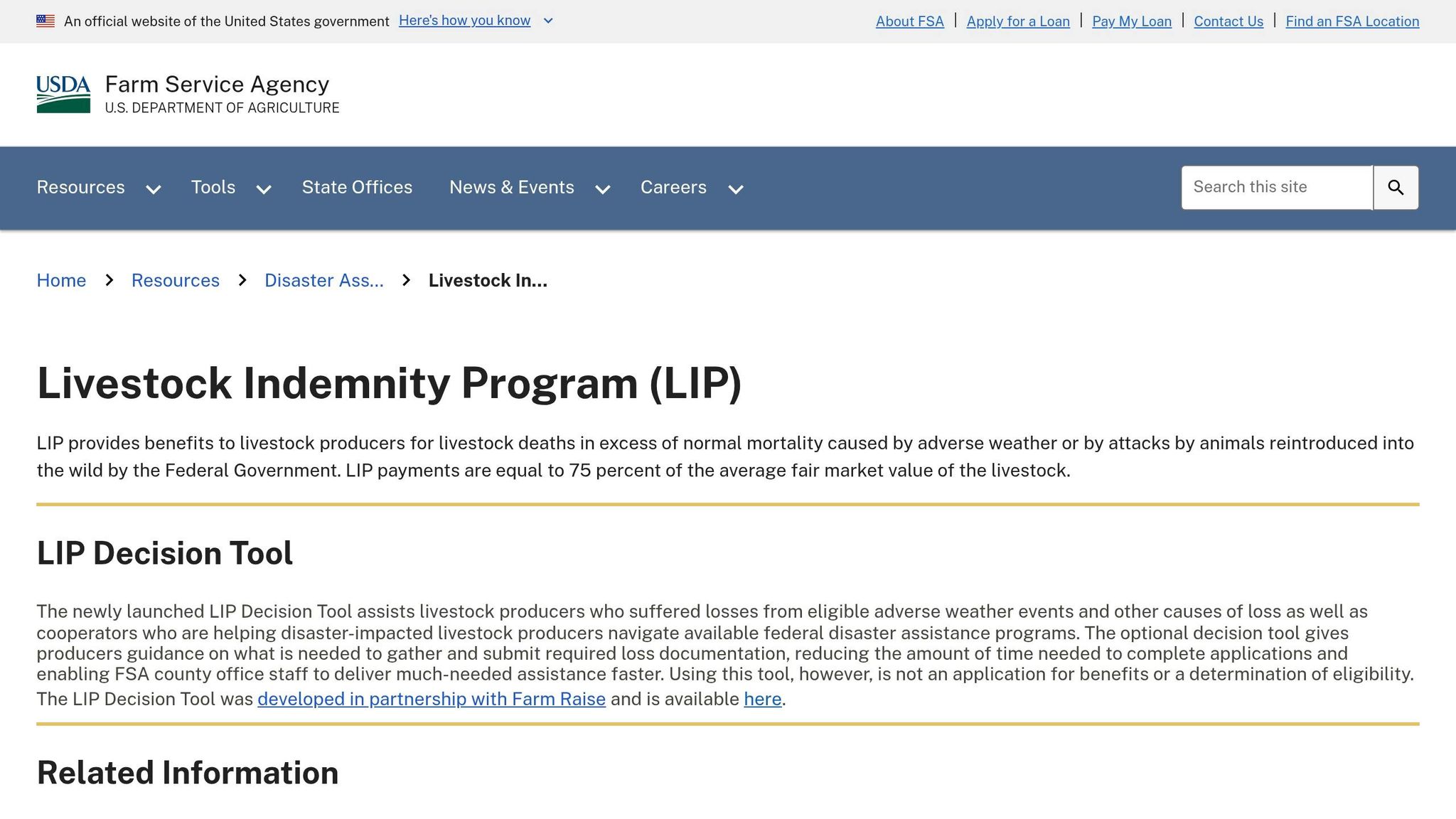
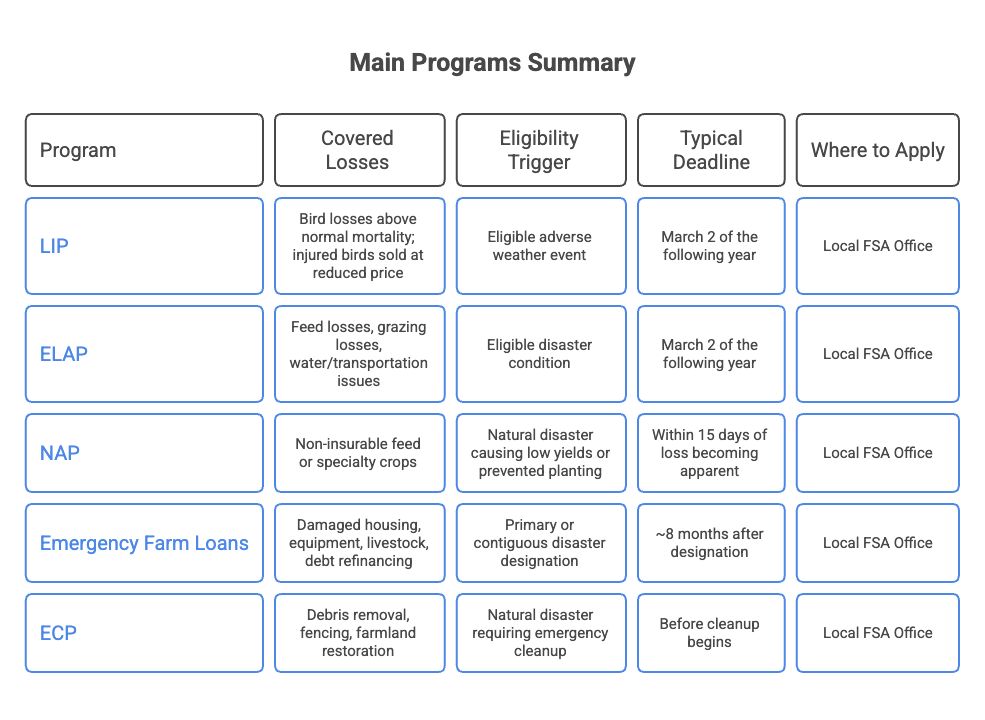
The Livestock Indemnity Program (LIP) covers bird losses above normal mortality after an eligible weather event. It may also help if you have to sell injured birds at a lower price. To qualify, you’ll need solid records that show your normal death loss. That’s how FSA figures out what counts as above normal.
LIP covers bird losses above normal mortality after an eligible weather event. ELAP can help with feed, water, and transportation losses tied to disaster conditions. Both programs share a March 2 deadline in the year after the loss. File with your local FSA office as soon as you can after the event, because the deadline controls eligibility.
NAP, Supplemental Disaster Aid, and Emergency Farm Loans
The Noninsured Crop Disaster Assistance Program (NAP) applies when a natural disaster causes low yields or prevents planting of crops that aren’t covered by standard federal crop insurance. For poultry farms, that can matter for on-farm feed crops. If a disaster wipes out a non-insurable feed crop, NAP may provide financial help. There’s a catch, though: you must file a Notice of Loss (Form CCC-576) within 15 days of when the loss becomes clear.
The Supplemental Disaster Relief Program (SDRP) can add disaster aid after major events.
FSA Emergency Farm Loans are low-interest loans for producers in counties with a primary or contiguous federal disaster designation. Farms can use them to repair or replace poultry houses, buy equipment or livestock, or refinance farm-related debt. Loan application deadlines usually land around 8 months after the disaster designation date.
The table below sums up the main programs at a glance.
After federal options, compare state programs that can fill cash-flow gaps and speed early recovery.
State Disaster Recovery Programs in Arkansas and Nearby States
Once you know where federal help stands, the next step is to check state programs. This layer can matter a lot because state aid changes by location, and in some cases it moves faster than federal support. What you can get depends on two things: where your farm is located and what kind of disaster occurred.
Some states offer direct loans or grants. Others mostly help producers find the right federal program, pull together records, and move through the recovery process without getting lost in paperwork.
Arkansas Resources and State Coordination for Poultry Recovery
In Arkansas, state-level disaster help for poultry farms is mostly built around coordination and referrals. The Arkansas Department of Agriculture and the Arkansas Farm Bureau generally help connect producers with USDA Service Centers. They also help coordinate guidance on debris removal and infrastructure recovery.
That means Arkansas often plays more of a connector role than a direct funding role. For many poultry growers, the state’s main value is helping them get to the right office, the right forms, and the right next step.
Other nearby states handle this very differently. Some put loan money on the table. Others stay focused on agency-led referrals and document support.
Texas, Georgia, Kentucky, and Regional Relief Patterns
Georgia has been one of the more active states in setting up direct relief programs. In November 2024, Georgia launched SAFETY 24, a relief loan program that offered up to $500,000 at 2% fixed interest for FEMA-designated disaster areas, with applications submitted by email or mail to the Georgia Development Authority in Monroe, GA. Producers had to provide third-party loss verification from a crop insurance agent, UGA Extension, or FSA, along with a W-9 and an Operating Credit Continuity Agreement from their primary lender.
Kentucky leans much more on federal channels. State agencies there mainly help with referrals and documentation, sending producers to local FSA county offices for programs like LIP, ELAP, and Emergency Farm Loans.
Texas often handles relief in a more event-specific way. Help may target housing, equipment, and production losses, with applications usually going through the Texas Department of Agriculture or USDA Service Centers.
State aid can help cover immediate gaps while federal claims and loans are still moving. Once you identify the right program, pull together your loss records and file as soon as you can.
Eligibility, Records, and Application Steps That Speed Up Approval
Who Can Qualify and What Documents Poultry Farms Need
Once you pick the right program, approval usually comes down to three things: eligibility, records, and timing.
Both farm owners and contract growers may qualify for disaster aid, but the rules change by program and by disaster declaration. In many cases, the farm must be located in a primary or contiguous county, and the poultry operation must have been active before the official disaster date listed in the declaration.
Start by filing your FSA Form 578 producer print. Then pull together the records that back up your claim:
If Form 578 isn't already on file, contact your local FSA county office to complete an FSA crop and livestock report.
For contract growers, there's one detail that can matter a lot. If you don't use standard operating credit, you may be able to submit a letter of intent from your poultry integrator stating that the relationship will continue. That letter can serve the same role as the Operating Credit Continuity Agreement some lenders ask for.
Application Timeline: From Notice of Loss to Payment or Loan Closing
Act fast, but don't rush past the paperwork. The cleanest claims usually follow the same path.
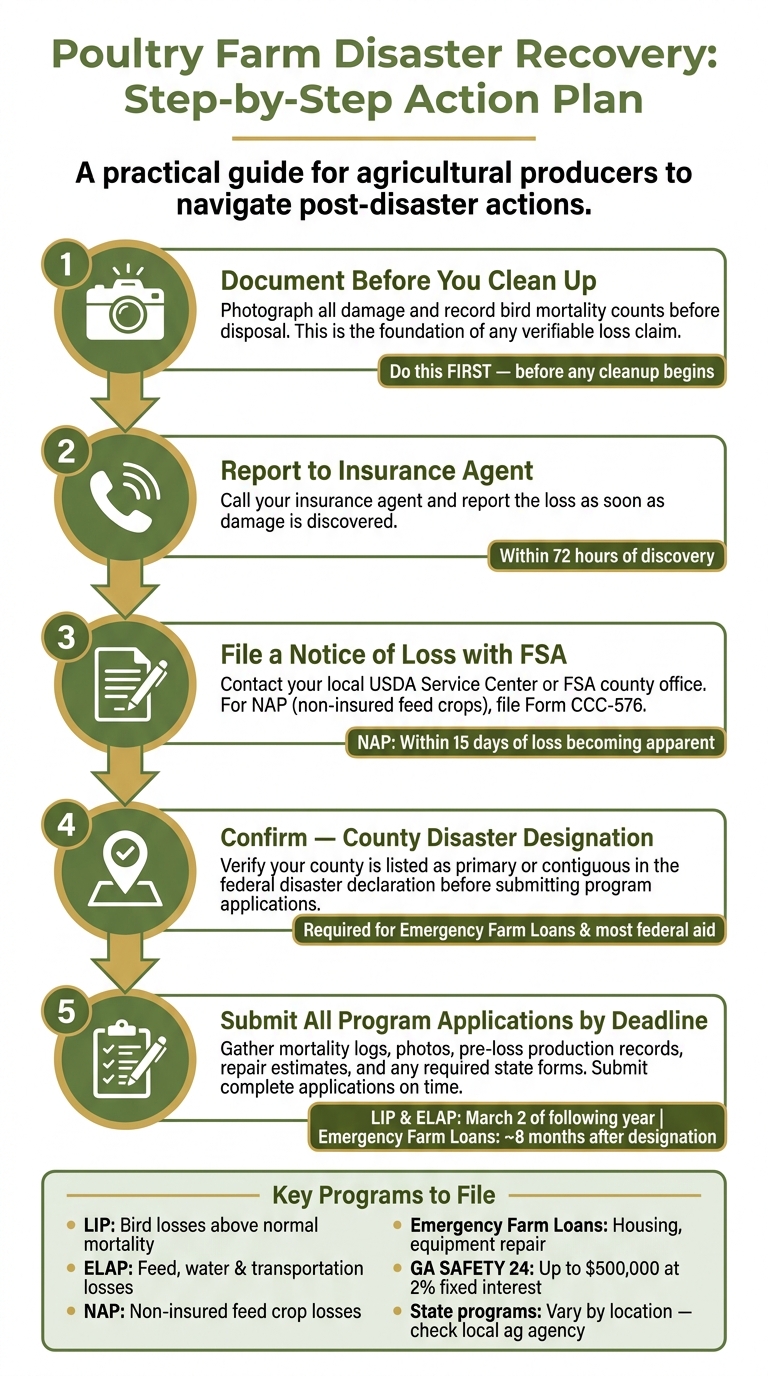
Take photos of all damage and record bird mortality counts before disposal. This proof is the base of any verifiable loss claim.
Contact your local
Make sure your county is listed as primary or contiguous before you file.
State deadlines can move fast, so send the full application by the posted date.
Step 5 - Reply fast to any follow-up request.
The claims that move fastest usually start with the right paperwork the first time.
Before you send any state loan application, confirm that all lender signatures are in place.
Conclusion: Build a Recovery Plan Before the Next Disaster
Recovery moves faster when your insurance, records, and aid applications all line up. Once the paperwork starts, the next part is simple in theory but hard in practice: keep your coverage current, keep your records in order, and file each form on time.
Act fast after a loss. Report damage to your insurance agent within 72 hours of discovery, file NAP losses within 15 days, and meet the March 2 deadline for LIP and ELAP claims.
Key Actions Poultry Producers Should Take Now
Use this checklist now:
Martin Agency can review poultry coverage, spot gaps before a loss, and help organize the records needed for insurance and disaster-aid claims.
Preparation before a disaster shortens every step after it.
FAQs
Which program fits my poultry loss?
Start by figuring out what kind of loss happened.
LIP applies to livestock deaths above normal mortality or reduced sales caused by adverse weather.
If the loss involves feed or grazing, ELAP may apply.
Martin Agency also offers personalized farm and poultry insurance to help protect your operation from disease outbreaks, contamination, and natural disasters.
What records should I gather first?
Start with records that confirm your farm’s status and losses.
Gather:
You’ll also want proof of the losses themselves. That can include damage photos, repair receipts, and records showing higher production costs.
Think of it this way: the clearer your paperwork, the easier it is to show what happened and how it affected your operation.
Do contract growers qualify for state or USDA aid?
Yes, contract growers may qualify for some USDA assistance. In most cases, eligibility depends on showing active involvement in the farming operation, not just owning land.
The exact rules depend on the program and the type of disaster aid or loan involved. You may need to provide proof of your role in the operation, such as signed sales or service contracts. Your local USDA Service Center can tell you what applies to your setup and business structure.
Related Blog Posts
- Poultry Farm Insurance: Coverage Checklist for 2025
- Protecting Your Poultry Farm: Common Risks and Insurance Solutions
- Insuring Poultry Farm Equipment and Structures: What You Should Know
- Livestock Insurance: Disease Coverage Basics
{"@context":"https://schema.org","@type":"FAQPage","mainEntity":[{"@type":"Question","name":"Which program fits my poultry loss?","acceptedAnswer":{"@type":"Answer","text":"<p>Start by figuring out <strong>what kind of loss happened</strong>.</p> <p><strong>LIP</strong> applies to livestock deaths above normal mortality or reduced sales caused by adverse weather.</p> <p>If the loss involves feed or grazing, <strong>ELAP</strong> may apply.</p> <p><a href=\"https://martinagencyinc.com/\">Martin Agency</a> also offers personalized farm and poultry insurance to help protect your operation from disease outbreaks, contamination, and natural disasters.</p>"}},{"@type":"Question","name":"What records should I gather first?","acceptedAnswer":{"@type":"Answer","text":"<p>Start with records that confirm your farm’s status and losses.</p> <p>Gather:</p> <ul> <li> your farm operating plan </li> <li> ownership or lease agreements </li> <li> income records, such as IRS Schedule F and CCC-941 </li> <li> production records, including yield reports, sales receipts, and inventories </li> </ul> <p>You’ll also want proof of the losses themselves. That can include damage photos, repair receipts, and records showing higher production costs.</p> <p>Think of it this way: the clearer your paperwork, the easier it is to show what happened and how it affected your operation.</p>"}},{"@type":"Question","name":"Do contract growers qualify for state or USDA aid?","acceptedAnswer":{"@type":"Answer","text":"<p>Yes, contract growers may qualify for some USDA assistance. In most cases, eligibility depends on showing <strong>active involvement</strong> in the farming operation, not just owning land.</p> <p>The exact rules depend on the program and the type of disaster aid or loan involved. You may need to provide proof of your role in the operation, such as signed sales or service contracts. Your local USDA Service Center can tell you what applies to your setup and business structure.</p>"}}]}