A weekly farm walk can help you spot theft risks before cattle go missing. In one April 2026 Texas case, about 70 head of cattle were stolen and slaughtered, with losses estimated at $30,000 to $150,000.
If I wanted the short version, I’d focus on four things:
- Lock access points like gates, chains, and back entrances
- Check weak spots such as fences, pens, chutes, and loading areas
- Use clear animal ID with tags, brands, microchips, and current photos
- Keep records current so I can report losses and support an insurance claim
The main idea is simple: routine helps me spot problems fast. If I check the same route each week, count animals, look for cut fences, review cameras, and keep sale and movement records in one place, I’m more likely to catch trouble early.
A short farm checklist should cover:
- Gates and locks
- Fence lines near roads
- Barns, sheds, and toolboxes
- Lights and cameras
- Animal counts and ID records
- Suspicious vehicle or damage notes
- General farm insurance policy review once a year
Small gaps often lead to big losses. This checklist is about closing those gaps with simple weekly habits.
Protect Your Herd: Preventing Cattle Theft | Cow-Calf Corner
sbb-itb-b725090
1. Secure access points, fences, and animal identification
Start with the places thieves use to get in, load animals, and get back out: gates, fences, and animal ID.
Gates, locks, and hidden entry routes
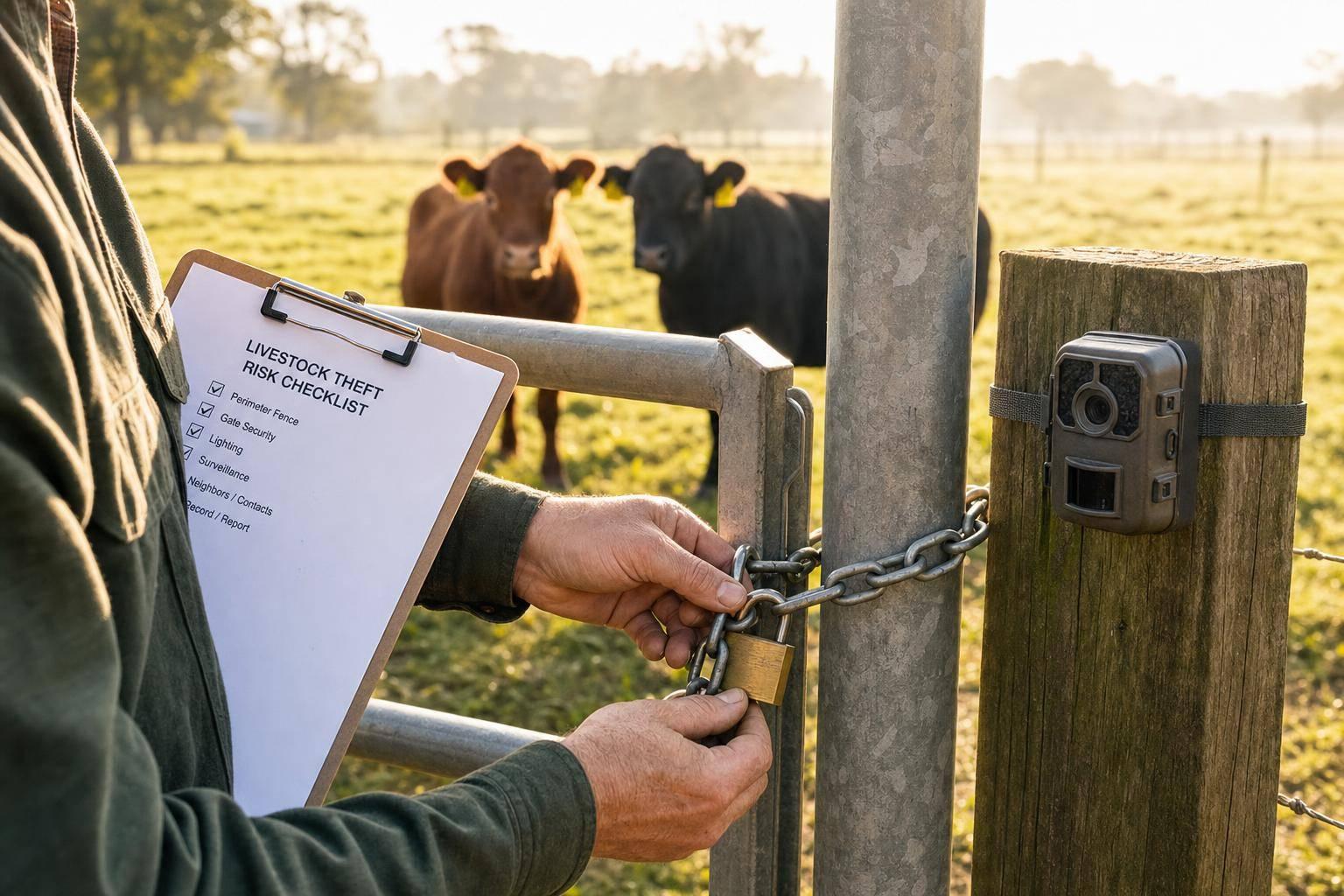
Close and lock every gate after you use it, even the ones you rarely touch.
Put strong chains and padlocks on all gate entrances. And don't leave keys in trucks, tractors, or other equipment.
If you have unused lanes or back entrances, block them with a barrier that can stop truck access. If trailers or equipment need to stay outside overnight, park them as far from public roads as you can.
Fence condition and roadside exposure
Walk your perimeter fences on a regular basis. Look for fresh cuts, loose wire, or damage that keeps showing up in the same spots.
Give extra attention to corners and pasture edges near public roads. Those areas give thieves a shorter route to a trailer waiting nearby.
Tags, brands, microchips, and photos
Animal identification can help discourage theft. The Mississippi Agricultural & Livestock Theft Bureau says:
"Branded livestock are rarely stolen." - Mississippi Agricultural & Livestock Theft Bureau
Check that tags, brands, and microchips are in place, easy to read, and matched to your records and brand registration. Keep brand registration current.
It also helps to keep up-to-date photos, written descriptions, and ID numbers in your farm inventory. That way, your records match the animals on-site and can help with recovery if anything goes missing.
After the perimeter, check the loading points and the places animals can be moved off the farm.
2. Check pens, loading areas, lighting, and cameras
After the perimeter, shift to the spots where animals are grouped and moved. That means pens, chutes, ramps, and barn doors. These are common theft points, especially when no one is around or when work happens after dark.
Pens, chutes, ramps, and trailer access
Try to keep pens and holding areas in view of your main residence whenever possible. If a pen sits far away or out of sight, it becomes a weak spot, especially when no one is nearby during the day.
Portable ramps and chutes shouldn’t be left loose when they’re not in use. Chain and lock them to a fixed post or rail. Before any animals are moved, log the transporter, truck, and plate number.
Motion lights and camera placement
Install motion lights at gates, barn doors, corrals, and loading zones. Start camera placement at the main gate and driveway so you can record vehicles and license plates. Then add coverage at loading ramps, barn doors, storage rooms, and remote fence lines.
For remote paddocks, use trail cameras. That way, you get two things: a clear deterrent and a record to review if theft occurs.
3. Keep records that support recovery and insurance claims
Once the physical checks are done, lock down the paperwork too.
Current records help you prove ownership, track losses, and back up a claim fast. They also make life harder for thieves and give you something solid to hand over when you're dealing with an insurer or law enforcement.
Inventory, movement logs, and sale documents
Keep an up-to-date head count for each pasture or pen. Record every birth, death, purchase, sale, or transfer as it happens. When something changes, write it down right away.
Store bills of sale, health papers, and transport records in one secure place that's easy to reach during an emergency. If you're scrambling after a theft, you don't want to dig through drawers or old folders.
Photos, incident notes, and policy review
Take dated photos and short videos once a season. Animals change as they grow, so older images lose some of their use over time. Newer visuals give you a clearer record if you need to show what was missing or identify an animal later.
Along with photos and video, keep a simple incident log for suspicious activity, like an unfamiliar truck near the gate or a fence section that looks tampered with. Small notes like these can give law enforcement needed context if a theft report is filed.
Review your farm insurance policy once a year. Herd values shift with purchases and sales, so coverage that fit a few months ago may not be enough now.
Recordkeeping table for quick review
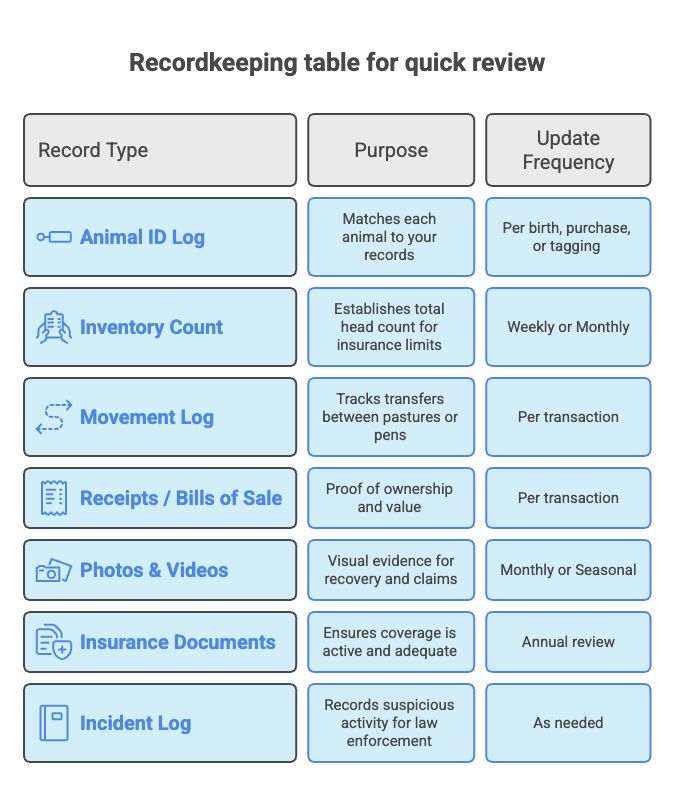
Use this record set during the family walkthrough below.
4. One-page farm walkthrough checklist for family or workers
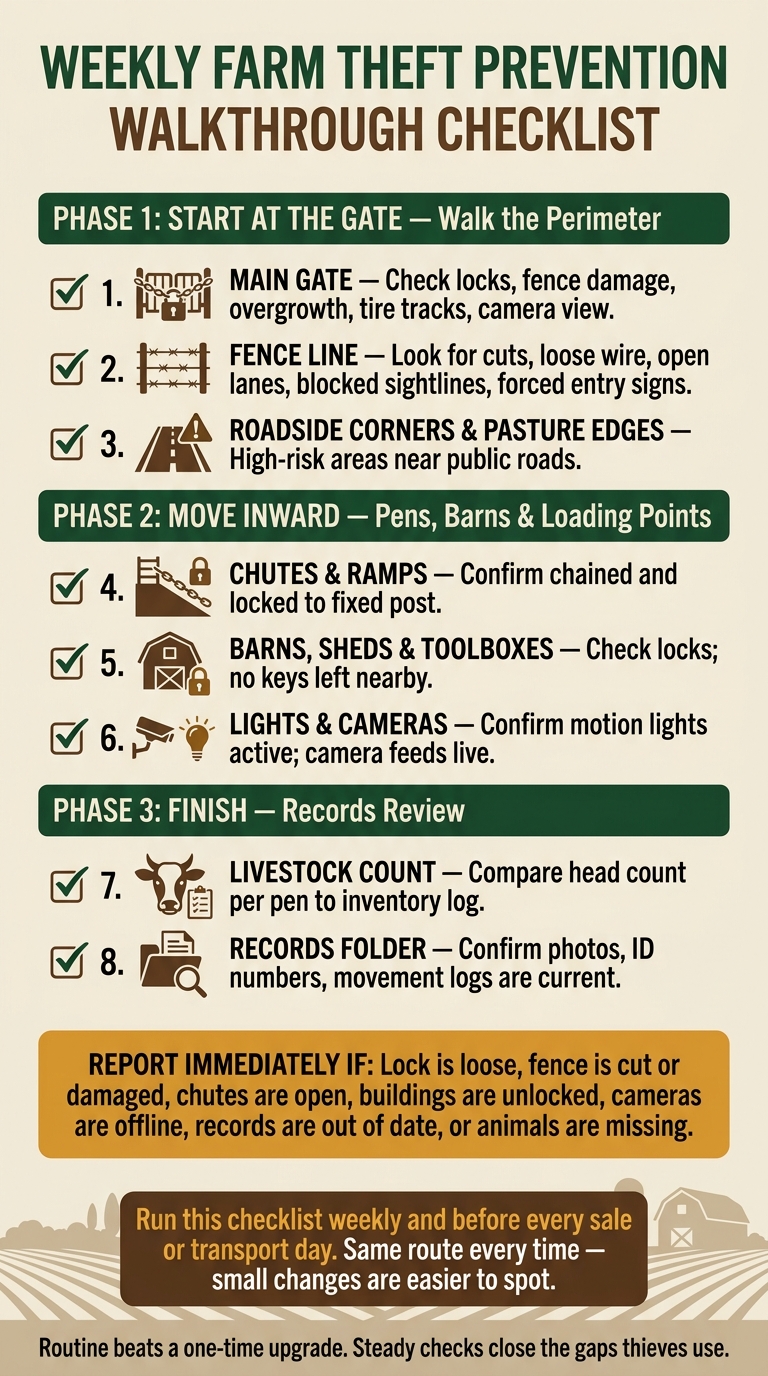
Use these records during a fast weekly walk-through. Run this checklist once a week and again before sale or transport days. Stick to the same order every time. That way, damage, tire tracks, or tampering are easier to spot.
Start at the gate and walk the perimeter
Begin at the main gate. Check the locks, fence damage, overgrowth, tire tracks, and the camera view.
Take the same route each time. Small changes stand out more when the routine stays the same.
Look for open lanes, blocked sightlines, fresh tire tracks, and any sign of forced entry.
Then head inward to the pens and loading points, where animals could be removed.
Finish at pens, barns, and the record folder
Move inside and check chutes, ramps, trailer access, barns, sheds, toolboxes, lights, and cameras.
Finish at the records file. Count livestock in each pen and compare that count to your inventory. Make sure photos, descriptions, ID numbers, and movement logs are current. Use the record folder to confirm ownership and help speed up recovery or claims. Report missing animals, damaged gates, cut fences, or suspicious vehicles right away.
Conclusion: A short checklist can reduce farm theft risk
The checklist helps because theft often slips through small gaps, not just after a big loss. In the April 2026 Williamson County, Texas case, the theft came to light because the herd count was off. That tells you something simple but important: steady routines matter more than any one new fix.
Routine beats a one-time upgrade. Gates, fences, animal ID, loading areas, lights, cameras, and records are the main controls. When you check them on a regular basis, you shut the openings thieves tend to use.
Simple deterrents and steady checks make theft harder. A regular walk-through can help you catch issues early, before a small problem turns into a bigger loss.
If your records, fences, and access points need a closer look, start with a farm coverage checklist like the one provided in this article. For farm coverage questions, Martin Agency offers farm and poultry insurance for families and farm owners.
FAQs
How often should I do a livestock theft check?
Check livestock daily so you can catch problems early, whether that’s a missing animal, signs of trespassing, or something else that looks off.
Update your digital records quarterly. Include each animal’s species, breed, identification tags, and market value. Regular counts and accurate records make it easier to spot losses and give you the paperwork you’ll need if you report a theft.
What animal ID works best for theft recovery?
The best IDs for theft recovery pair permanent markings with clear digital records.
For cattle, freeze-branding works well as both a deterrent and a recovery tool. For sheep, bright, one-of-a-kind, well-kept flock marks do the job.
It also helps to keep full records for every animal, including species, breed, age, and official ID numbers such as RFID tags or microchips. That gives law enforcement more to work with and makes insurance claims easier to handle.
What records should I keep after a theft?
After a livestock theft, organized records can help law enforcement move fast. Save:
- animal movement records
- current inventory and frequent count logs
- animal tag or passport numbers
- photos, written records, and any signs of trespassing
Share this information with law enforcement as soon as possible. It can help them spot leads and alert auctions or abattoirs.