Livestock Insurance: Disease Coverage Basics
If disease coverage is not listed in writing, I should assume it is not covered. That is the main point. Livestock disease claims usually depend on the trigger, the named disease, the waiting period, and whether I followed reporting and biosecurity rules.
Here’s the short version:
- Basic mortality may pay when an animal dies from a covered cause.
- Named disease coverage only pays for diseases listed in the policy.
- Government-ordered depopulation coverage usually starts with a written order.
- Business interruption or extra expense may help with lost income and shutdown costs, but often only if added.
- Standard farm and poultry insurance often does not include disease loss by default.
- Waiting periods are often 15 to 90 days.
- USDA and APHIS programs may help with some losses, but they often do not pay for lost future income.
A disease event can hit a farm from several sides at once: animal death, forced culling, no animal movement, cleanup bills, and delayed restocking. That can mean a fast cash-flow problem even before a claim is paid.
Livestock Insurance Basics
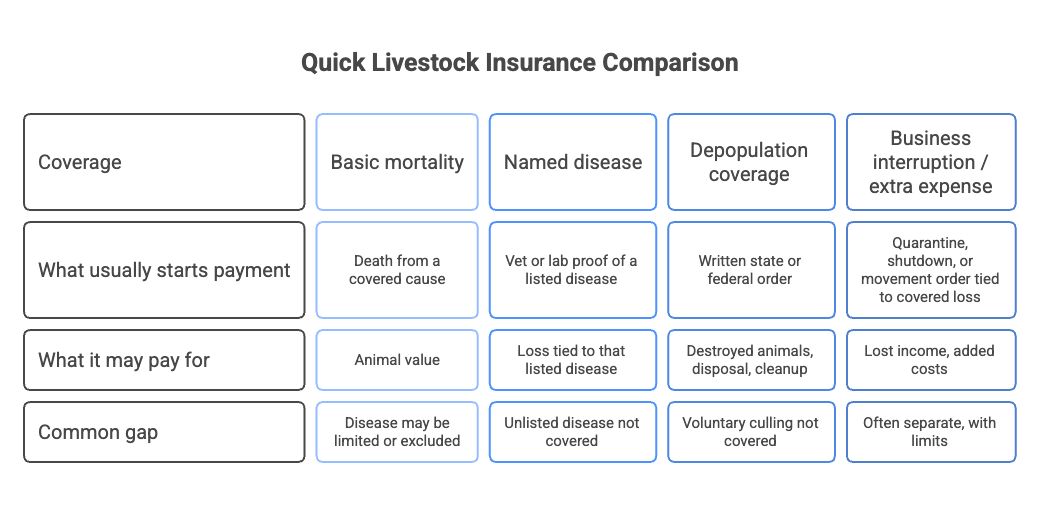
When I read a livestock disease policy, I want to check five things first: disease name, trigger, species, waiting period, and sublimits. Then I want records ready: vet reports, lab results, inventory counts, disposal receipts, and all agency notices.
That is the core of this topic, and it is what drives whether a claim gets paid, reduced, or denied.
Types of livestock disease coverage and common policy triggers
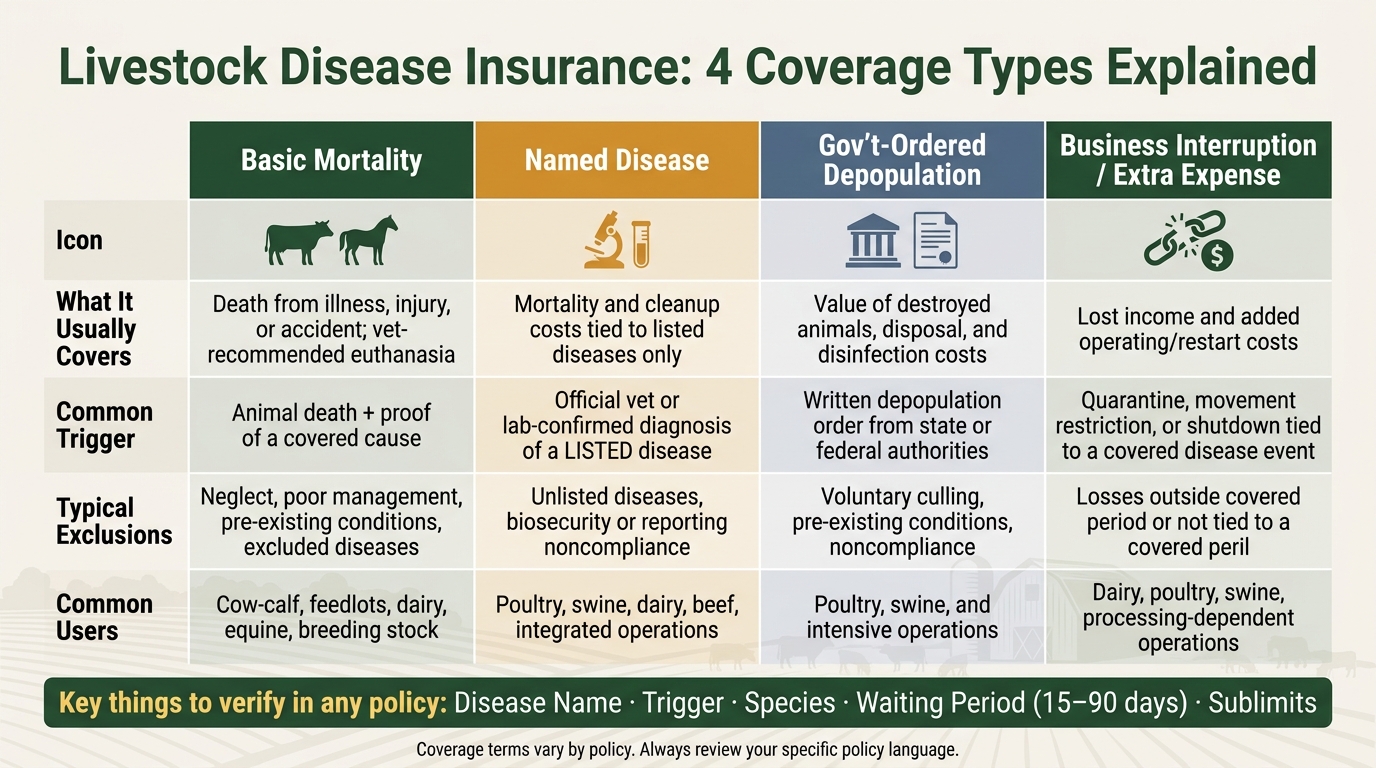
The trigger is what starts payment. That’s why producers usually run into four main types of coverage: basic mortality, named disease, government-ordered depopulation, and business interruption/extra expense. Once the trigger comes into play, the next issue is simple: which policy form actually responds.
Basic mortality vs. named disease and government-ordered depopulation coverage
Basic mortality coverage is the starting point for many livestock insurance programs. It pays when an insured animal dies from a covered cause, such as illness, injury, or accident. It may also cover veterinarian-recommended euthanasia for a covered condition. The protection can be broad, but it still comes with exclusions and policy conditions. Some standard farm policies leave out disease unless it is added by endorsement or placed under separate mortality coverage.
Named disease coverage works in a much narrower way. It pays only for diseases listed in the policy, such as HPAI or foot-and-mouth disease. If the disease is not named, there is no payment. These policies often require a confirmed diagnosis from a licensed veterinarian, usually backed by lab testing. Some also require official confirmation from a state veterinarian or USDA/APHIS.
Government-ordered depopulation coverage applies when state or federal officials order animals to be destroyed to control a disease outbreak. The key trigger is the written depopulation order, not just the fact that animals died.
Business interruption/extra expense coverage deals with the money side of the loss. It helps with lost income and added costs after a quarantine, shutdown, or depopulation event.
Coverage type and trigger are not the same thing. One tells you what the policy protects. The other tells you when the claim starts.
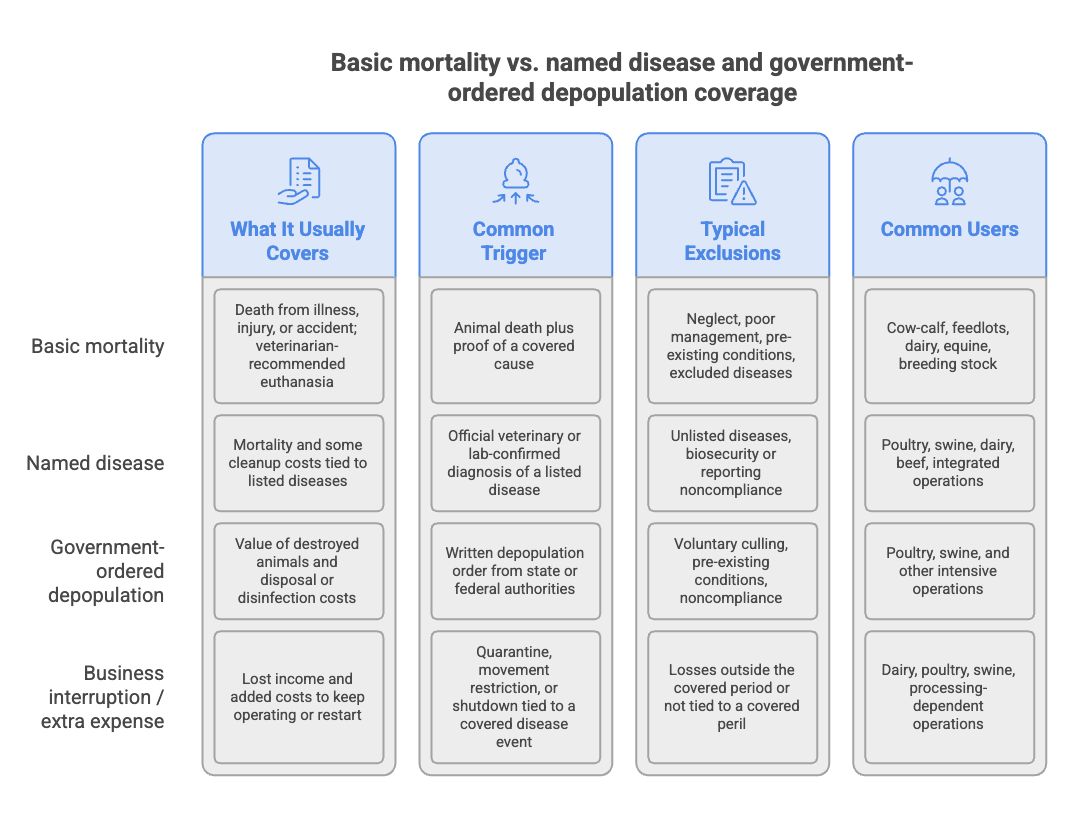
Many animal policies also have a waiting period after the policy starts before illness or disease coverage kicks in. Deductibles, sublimits, and valuation methods can also change claim payment in a big way, even when two policies seem almost the same on the surface.
Common trigger events for outbreak-related claims
Most outbreak claims turn on documented diagnosis, required reporting, and policy compliance. In plain English, the outbreak has to be documented in a form the policy accepts.
A confirmed veterinary diagnosis is often the first step. Insurers usually want a licensed veterinarian’s report that explains the symptoms, diagnosis, and date of first detection, along with lab results if testing was done. That date often sets the claim timeline.
Mandatory reporting is another common condition. Many serious livestock diseases must be reported to state or federal agencies. If the policy requires reporting and the producer misses the deadline, coverage may be at risk. Insurers may ask for copies of reports sent to state veterinarians or USDA/APHIS, plus any case numbers those agencies issued.
A quarantine or movement restriction order can become the core document in a business interruption claim. Insurers usually want the written order, the dates it applies, and records showing the farm followed its terms. The same goes for official depopulation instructions. Those should be in writing and should identify the disease, the species involved, and the number of animals ordered destroyed. Disposal receipts, scale tickets, and photographs can all help back up the claim file.
Producers with organized records, and who stay in close contact with veterinarians and regulatory agencies during an outbreak, are often in a better spot when it’s time to file a claim. The next step is proving the event with records, reports, and written orders.
What disease outbreak coverage typically includes and excludes
Once a trigger is met, payment still comes down to one thing: what the policy says counts as a covered loss. The trigger opens the door. The coverage terms decide what gets paid, what gets cut, and what gets denied.
Covered losses: mortality, culling, disposal, cleanup, and lost income
Disease outbreak coverage usually pays for losses above normal mortality when a covered disease is confirmed. It may also pay for ordered culling, carcass disposal, and required cleaning and disinfection when those costs are tied to a covered outbreak and fit the policy terms.
USDA APHIS indemnity usually covers destroyed animals and some cleanup costs. It does not usually cover production losses or business interruption. If a farm wants income-loss protection, that coverage is often separate.
Excluded losses: routine sickness, poor management, and noncompliance
Routine and endemic illness - like common respiratory infections - usually falls outside disease outbreak coverage. Deaths during a policy’s waiting period are also excluded. That waiting period is often 15 to 90 days after the policy starts.
This is where many claims hit a wall. A loss may feel outbreak-related, but if it falls into an excluded bucket, payment can shrink or disappear.
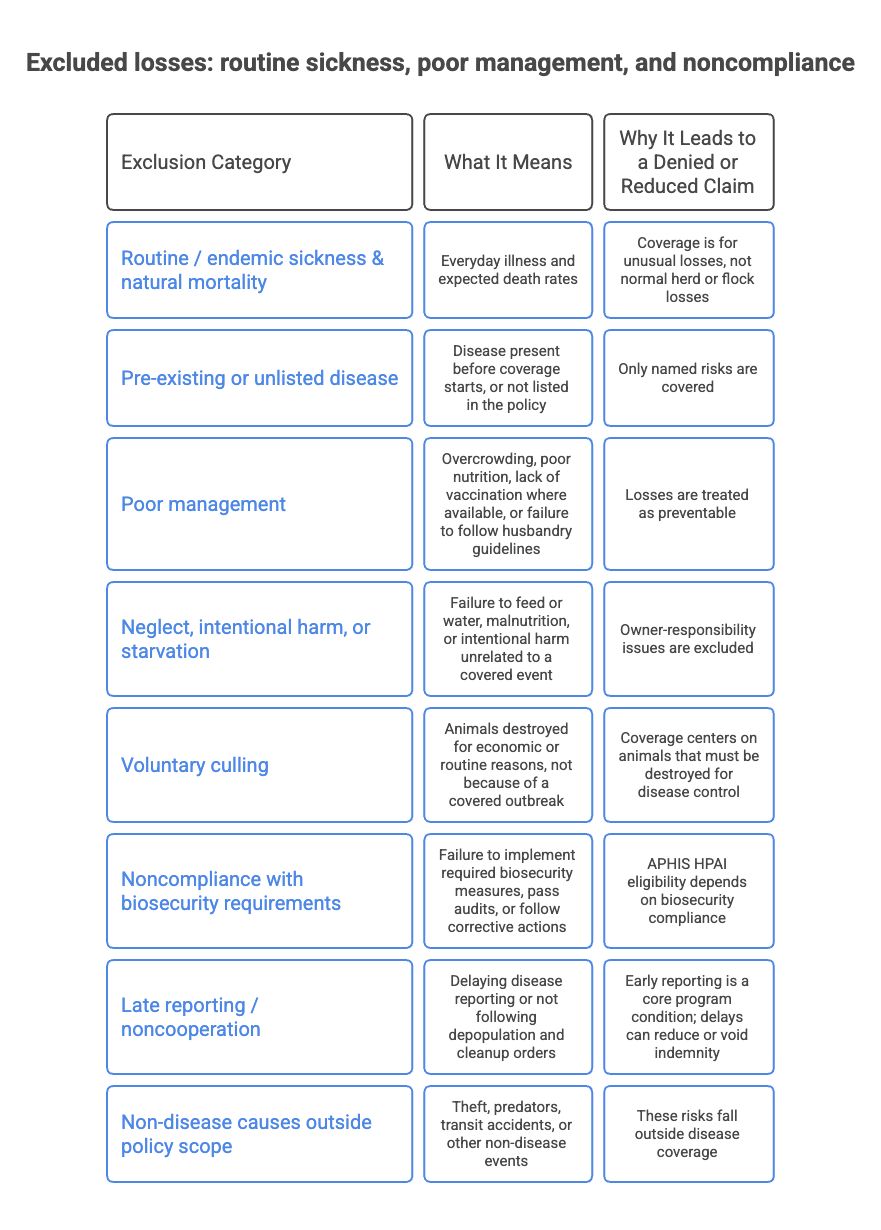
A lot of these exclusions come back to two plain issues: biosecurity and reporting. If records are weak, required steps are missed, or officials think the producer dragged their feet, the claim can go sideways fast.
Disease categories that may affect coverage
The type of disease matters for both private insurance wording and public program eligibility. Named contagious diseases - such as highly pathogenic avian influenza (HPAI) or foot-and-mouth disease - are covered only when they are listed in the policy or added by endorsement.Some standard farm policies leave out epidemic diseases by default, which means producers may need to add that protection for an extra premium.
For HPAI, APHIS indemnity covers live birds and eggs destroyed for disease control. It does not cover animals that died before officials arrived
Vector-borne diseases like bluetongue or epizootic hemorrhagic disease (EHD) may qualify under programs such as USDA’s Livestock Indemnity Program when they meet the program’s rules for an eligible disease. Weather-linked disease events - like anthrax after drought conditions or cyanobacteria blooms - may also qualify when the disease is tied to an eligible adverse weather event.
Even then, paperwork still matters. Veterinary confirmation and solid records are usually needed to back up the claim.
Biosecurity, records, and public programs after an outbreak
Once coverage depends on compliance, the record trail becomes the claim trail.
Farm biosecurity steps that can affect insurability
Biosecurity records help show that a farm followed the required risk controls. They also give the insurer something concrete to review if a claim comes in.
Document these steps: quarantine new or returning animals for 21–30 days before mixing them with the main herd or flock, visitor and vehicle access controls, equipment and footwear sanitation at entry points, feed and water protection from wild birds and rodents, pest-control logs, and carcass disposal procedures. Arkansas poultry guidance sums this up as "Clean, Cover, Isolate."
For commercial poultry hit by HPAI, APHIS now requires biosecurity audits and auditable plans as a condition for restocking and future indemnity on commercial poultry premises.
Those same logs can also help during USDA and APHIS review. If a file is thin, things can get messy fast.
How USDA and APHIS programs may work alongside private coverage
Public programs and private insurance do not pay for the same things. They also move on different timelines and ask for different proof.
The USDA Livestock Indemnity Program (LIP), run through USDA FSA, pays eligible livestock owners for animal deaths above normal mortality caused by qualifying loss conditions, including certain diseases made worse by adverse weather. APHIS compensation is tied to disease-control action. It pays for animals and eggs destroyed to control a disease like HPAI, plus depopulation, disposal, and cleaning and disinfection costs. APHIS does not pay for animals that died from the disease itself before officials arrived, and neither program covers lost future income or business interruption.
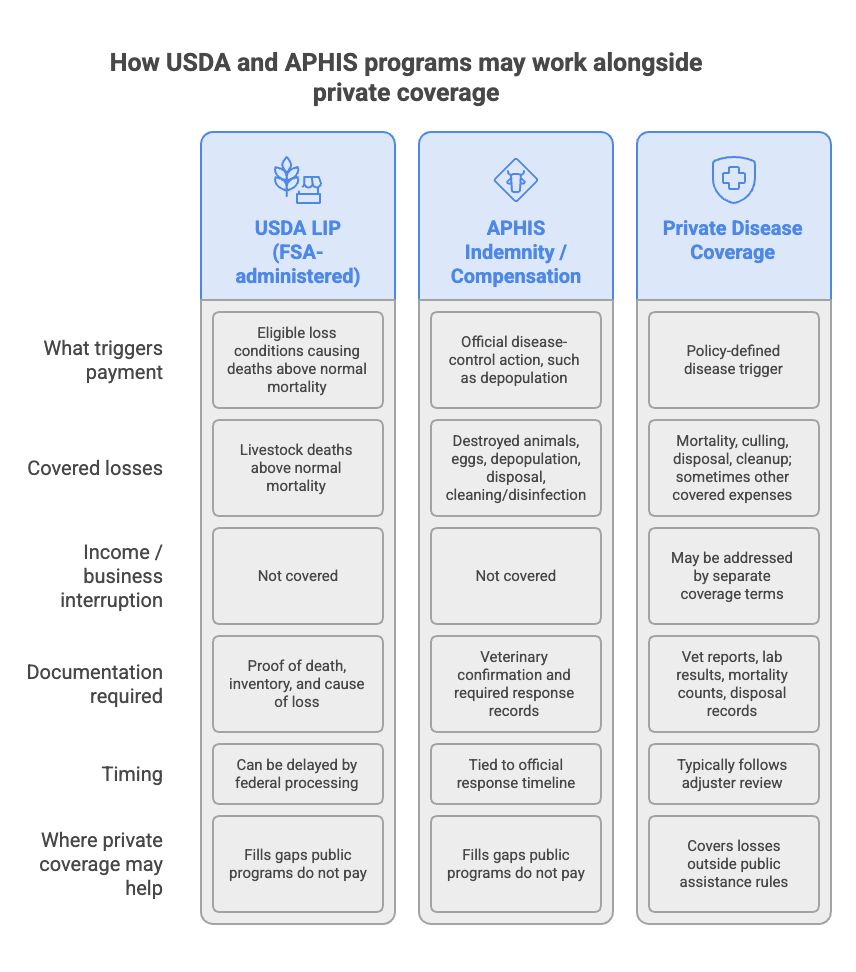
The practical takeaway is simple: do not assume LIP or APHIS will cover everything. Private coverage may fill the gaps, especially when a loss falls outside the narrow rules of a public program.
Records to keep for a stronger claim file
After the outbreak is documented, the next job is pulling together the claim file.
Keep:
- Herd or flock inventory records
- Purchase and sale receipts
- Vet and lab reports
- Mortality logs
- Disposal and sanitation invoices
- All official notices or movement orders
APHIS guidance also stresses keeping records of carcasses entering and exiting storage facilities and holding onto equipment sanitation logs tied to disposal.
Dates matter more than most producers think. The date a quarantine order was issued, the date officials arrived, and the date depopulation began can all affect which losses qualify - and under which program. A simple running log of official contacts and notices during an outbreak only takes a few minutes to keep, and it can head off major disputes later.
Conclusion: Key points to check before buying or renewing coverage
Before you renew, check the basics first: insured head count, species risks, disease triggers, deductibles, waiting periods, limits, and endorsements.
The fine print matters. But when a claim happens, documentation often decides how things play out. That’s why it helps to review your biosecurity steps, reporting duties, and all required records and compliance steps before you bind coverage. In plain English: your records are part of insurability, not just part of outbreak response.
If you want a local review of those terms and requirements, keep reading. For Arkansas farms and poultry operations, Martin Agency in Pocahontas can review coverage before renewal.
FAQs
How do I know if disease loss is covered?
Review your policy’s terms, conditions, and exclusions with care. Some plans don’t cover illness or disease, and that detail can make a big difference when you need to file a claim.
Farm operations can shift over time. You might add livestock, change how animals are housed, or take on new risks without thinking much about your insurance. That’s why it helps to check in with your insurance agent now and then to make sure your policy still matches your current operation and to spot any gaps in coverage.
It also pays to keep detailed, accurate records. Good paperwork can make the claims process a lot smoother when time matters most.
What documents do I need for a livestock disease claim?
Keep clear, current records for every insured animal. That means inventory logs that list species, breed, age, purchase price, current market value, and key dates tied to births, sales, or losses.
It also helps to keep photos, official ID details like RFID tags or microchips, and digital tracking records on hand. Those records can make verification much faster if you need to file a claim.
Martin Agency can help with the paperwork too. The team can gather documents, check compliance records, and handle your claim submission.
Will USDA or APHIS cover lost income after an outbreak?
USDA and APHIS programs mainly focus on disease surveillance, prevention, and control. They are not meant to serve as standard income replacement for private farms.
Federal aid may be available during major outbreaks. But it shouldn't be treated as a stand-in for full business interruption insurance or livestock coverage. That gap matters. If an outbreak slows sales, stops movement, or cuts into cash flow, government programs may not cover the income your farm loses.
For lost income after an outbreak, look at business income or loss-of-revenue coverage. Martin Agency offers farm insurance plans tailored to your operation, including options for revenue loss and livestock protection.