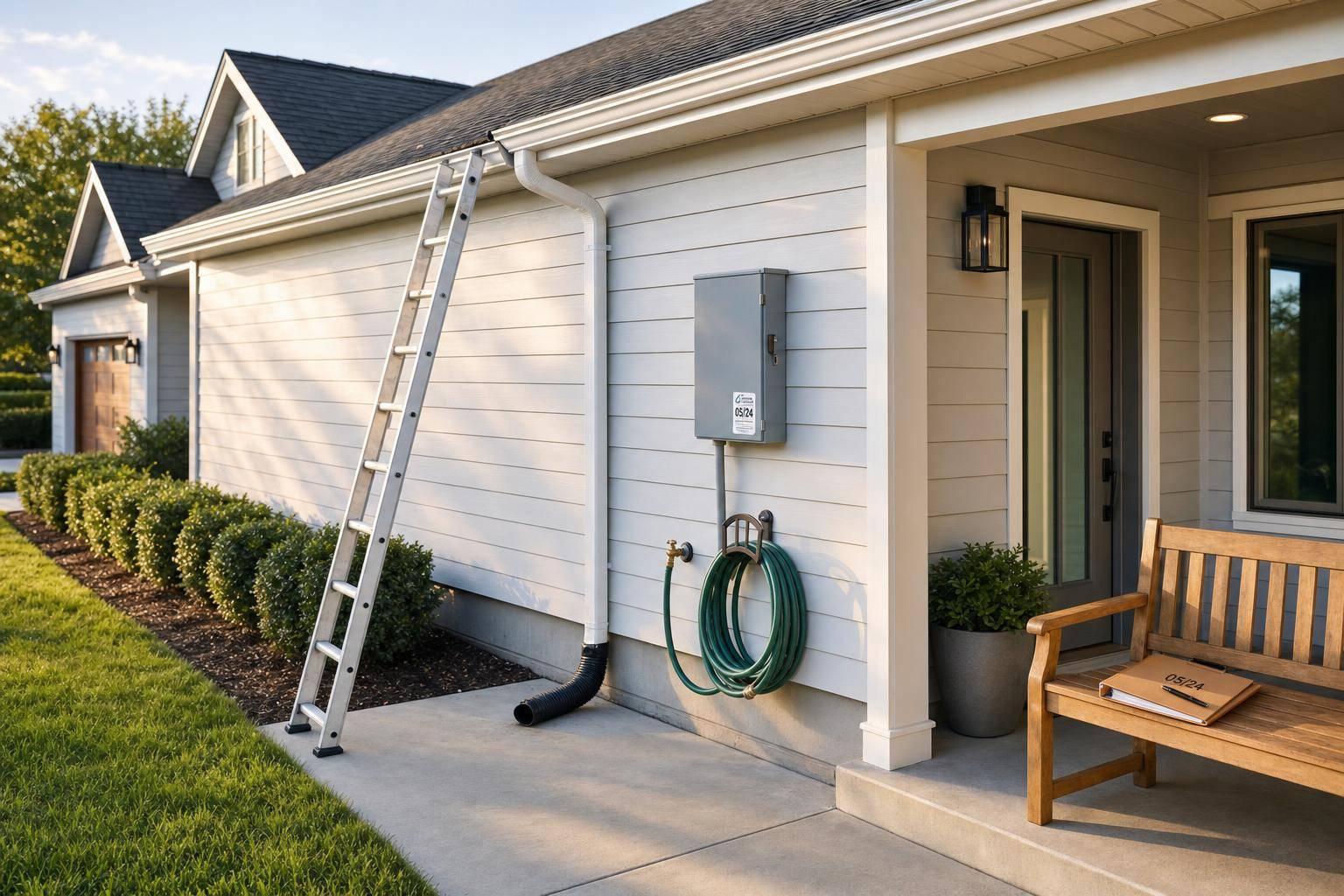
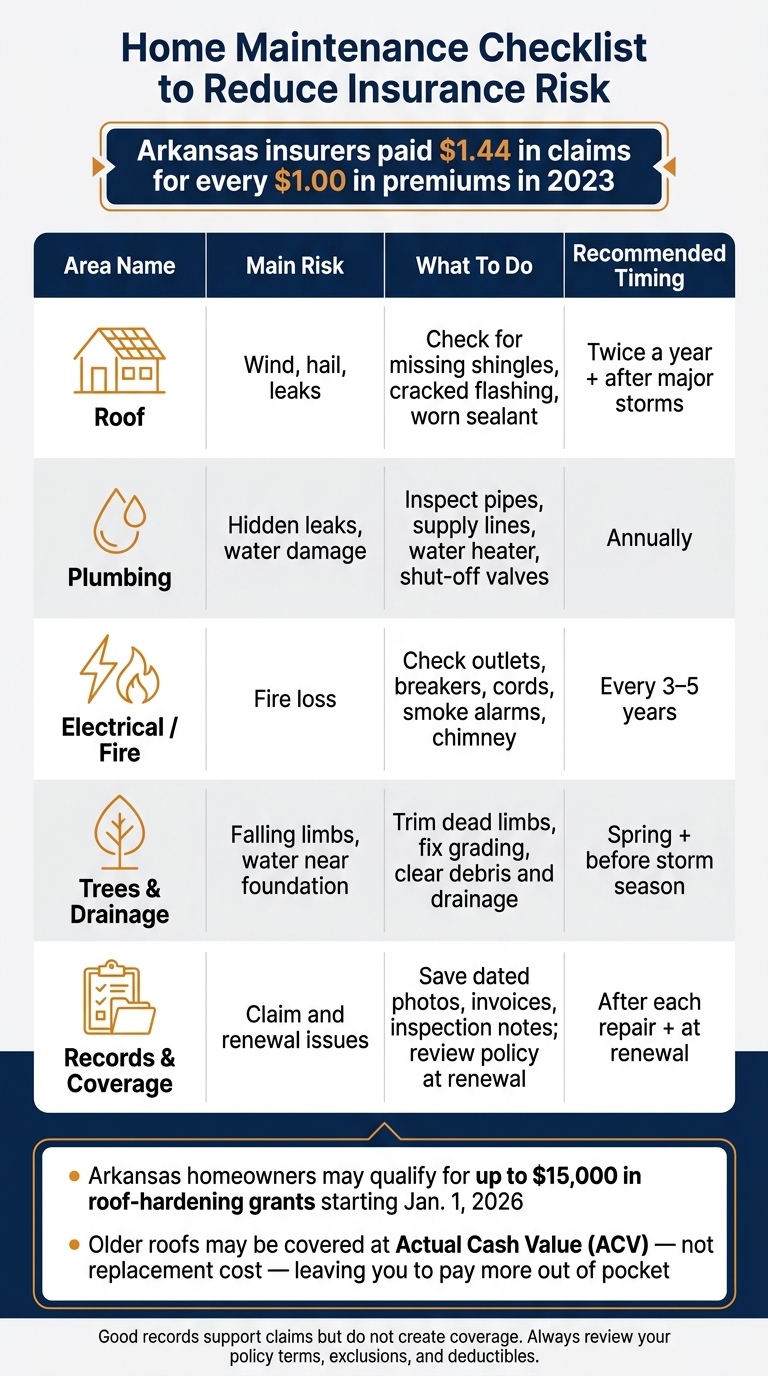
A few routine checks can help you avoid roof leaks, water damage, fire hazards, and yard-related losses that often lead to claims. I’d focus on five things first: the roof, plumbing, wiring, trees/drainage, and repair records.
Here’s the short version:
- Check the roof twice a year and after major storms
- Look for leaks around pipes, valves, and water heaters at least once a year
- Fix fire risks like bad wiring, overloaded outlets, and chimney issues
- Trim trees and correct drainage before storm season
- Keep dated photos, invoices, and inspection notes in one file
In Arkansas alone, insurers paid about $1.44 in claims for every $1.00 in premium in 2023. And some older roofs may be covered at actual cash value (ACV) instead of replacement cost, which can leave you paying more out of pocket. Arkansas homeowners may also qualify for up to $15,000 in roof-hardening grants starting January 1, 2026.
What I take from this is simple: maintenance helps lower risk, but it does not guarantee coverage. Claims still depend on your home and rental insurance policy, deductible, exclusions, and how the damage happened.
If I wanted one simple plan, I’d inspect the home on a set schedule, fix small problems fast, and keep proof of every repair.
Bottom line: small repairs now can help you avoid larger damage later, and good records can make claim and renewal questions easier to handle.
What Skipped Upkeep Can Cost You
A small defect can snowball into a claim issue fast. One loose shingle or a small pipe crack can let water in. What looked like a simple fix at first can turn into a much bigger claim if no one spots the damage in time.
Insurers separate sudden loss from wear and tear. Most homeowners policies cover sudden, accidental losses, like tornado or hail damage, but they usually do not cover gradual deterioration, long-term seepage, or damage tied to a problem that was never fixed. A leak that runs for months can lead to a denial or a smaller payout. You can see that risk most clearly when storm-related roof damage is involved.
This line matters even more in storm-prone states like Arkansas. The state recorded the second-highest homeowners loss ratio in the country in 2023, with insurers paying out about $1.44 in claims for every $1.00 collected in premiums. That kind of pressure has led insurers to look more closely at roof age and condition. If a roof is older or poorly maintained, coverage may be limited to actual cash value (ACV). That means depreciation gets subtracted, and the homeowner has to cover more of the bill.
Skipped upkeep can also affect whether your policy gets renewed. If underwriting inspections find repeat problems, an insurer may choose not to renew. That can push a homeowner into the surplus-lines market, where premiums are higher and coverage terms are narrower.
On rural properties, exterior upkeep matters even more. Detached structures and brush near the home can add risk, which is why the next checks focus on roofs, plumbing, wiring, and yard hazards.
sbb-itb-b725090
1. Inspect and Repair the Roof
Your roof’s age and condition can make a big difference, so it pays to look for trouble before a leak shows up. Check for missing shingles, cracked flashing, loose fasteners, and worn sealant. After severe storms, take another look so you can spot hail or wind damage early.
If you can see damage, or the roof is getting close to the end of its lifespan, bring in a qualified roofer for an inspection and repairs. That may mean patching exposed decking, replacing missing shingles, resealing flashing, and clearing debris from gutters and roof valleys.
If it’s time for a full roof replacement, use the FORTIFIED roof standard to improve resistance to wind and hail. Under Arkansas home insurance laws, homeowners may qualify for up to $15,000 in Strengthen Arkansas Homes grants starting Jan. 1, 2026.
Keep invoices, photos, and contractor notes on file as proof of the roof’s condition and any work completed. A dry roof is your first defense against water damage.
2. Prevent Plumbing and Water Damage
After the roof, hidden leaks are the next big risk.
Water damage is a major insurance issue, especially for rural homes. And the tricky part is that a slow leak behind a wall, under a sink, or near a crawl space can sit there for months without much warning. By the time you notice it, the damage may already be done. On top of that, repeated water claims can push a home into higher-cost surplus-lines (E&S) coverage.
Inspect your plumbing on a regular basis. Check visible pipes, supply lines, drains, the water heater, and shut-off valves for leaks, corrosion, or cracking. Test shut-off valves too. If a pipe fails, you need them to work right away, not only in theory.
If you spot an active leak or a problem that keeps coming back, don't wait. Fix it and keep the paperwork. Invoices and inspection records can help show that you've kept up the property.
Next, check the wiring and fire risks that can turn a small defect into a larger loss.
3. Fix Electrical and Fire Hazards
After water damage, the next preventable loss is fire. And fire risk can climb fast.
Faulty wiring, overloaded outlets, and problems with a woodstove or chimney are common trouble spots. Check cords, breakers, outlets, smoke alarms, and any wood stove or fireplace area for damage, buildup, or wear. If you spot an issue, repair or replace the part and keep a record of the work.
That paper trail matters. If an inspection flags concerns, insurers may ask for clear photos before binding coverage, and unresolved fire hazards can limit access to standard coverage. The gap usually comes from skipped repairs, not from the home itself.
Outside the home, trees, drainage, and debris can create the same kind of avoidable risk.
4. Manage Trees, Drainage, and Yard Hazards
Once you’ve handled the risks inside the home, head outside. The yard and perimeter matter more than many homeowners think. If vegetation gets too close to the house, that alone can lead to a non-renewal or even a policy decline.
During a routine walkthrough, check for a few common trouble spots:
- Dead or leaning trees
- Low branches hanging over the roof
- Loose debris that could blow into the home
- Drainage issues, like standing water near the foundation, erosion on a slope, or a ditch that’s backing up
If you clean something up or make a repair, document it before the next inspection. That small step can save a lot of back-and-forth later.
For diseased, hollow, or unstable trees, bring in a tree professional. It’s the safest way to reduce the chance of water intrusion or damage from a falling limb. And if the issue is poor grading or drainage, a drainage or grading contractor can help you figure out the right fix.
5. Record Repairs and Review Your Coverage
Once the work is done, write it down. Keep a dated repair log, and add photos and inspection reports after each repair. That paper trail can help show what shape the home was in before a loss.
It also helps to keep a simple property profile with details like:
- Roof age
- Square footage
- Construction details
Update that file after major work, like a roof replacement. And make sure it notes how the roof is insured - whether the policy pays replacement cost or actual cash value (ACV).
These records matter most when renewal season comes around. Review your coverage at renewal, or as soon as a non-renewal notice shows up. In Arkansas, insurers must send that notice at least 30 days before the policy expiration date. Keep your renewal notices, quotes, declinations, and current binder in one place.
If you’ve made big updates - like a new roof or new wiring - contact your agent right away.
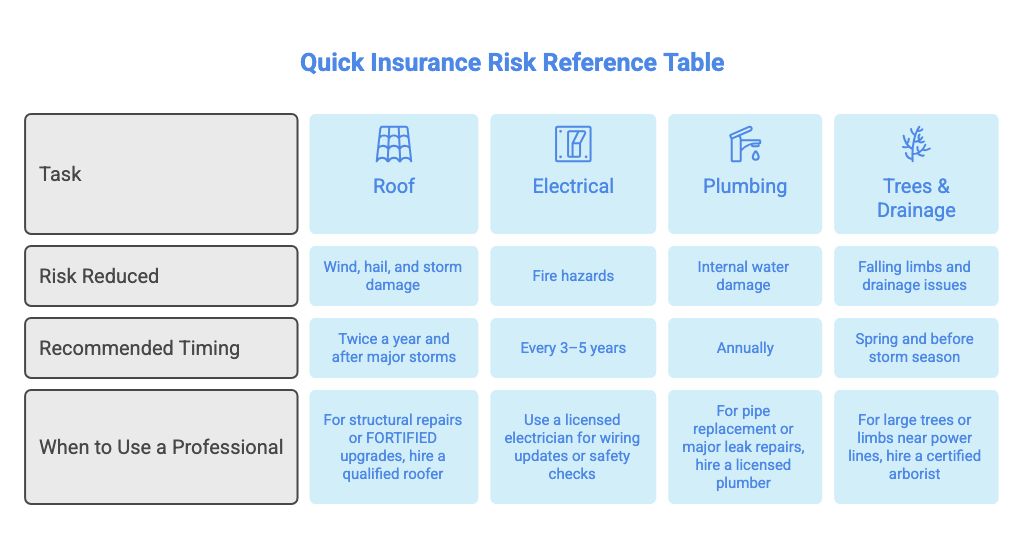
Quick Insurance Risk Reference Table
After the checks above, use this table to decide what to tackle next.
It’s a simple way to cut preventable insurance risk. You can see what to inspect, what to fix, and when it makes sense to bring in an expert.
Key Takeaways
Roof, water, fire, and yard issues cause much of the damage homeowners can prevent. Regular inspections, fast repairs, and dated records can lower the odds of avoidable claims.
That effort matters for another reason too. Good records can help after a loss by backing up your claim. But they don’t create coverage. Coverage comes down to your policy’s terms, exclusions, and deductibles.
One more thing to check: in Arkansas, wind and hail deductibles are often percentage-based instead of flat-dollar amounts.
FAQs
Will home maintenance lower my premium?
Yes, home maintenance can help lower your insurance premium.
Adding safety features like security systems, smoke detectors, and storm shutters may also qualify you for direct discounts.
There’s another upside too: keeping your home in good shape can help you avoid small claims. Over time, that may help you keep claims-free discounts.
Martin Agency can help you spot available savings and match your coverage to your needs.
What records should I keep for claims?
Keep clear records of your property and its condition. That means photos or videos of your home and outbuildings, plus an itemized list of personal property with the make, model, serial number, and purchase price for each item.
It also helps to save receipts and invoices for repairs, maintenance, and home upgrades, along with your policy documents and any claim-related correspondence. Store these records digitally or in a secure off-site location so you can still get to them when you need them.
When should I call a professional?
Call a professional insurance agent if you want a detailed property review that can help spot weak points you may have overlooked.
It also makes sense to get in touch if your policy feels unclear, if you need to fix coverage gaps, or if you want to check that your plan matches your needs and local risks. For personal guidance, contact Martin Agency in Pocahontas, AR, at 870-892-5222 or rob@martinagencyinc.com.