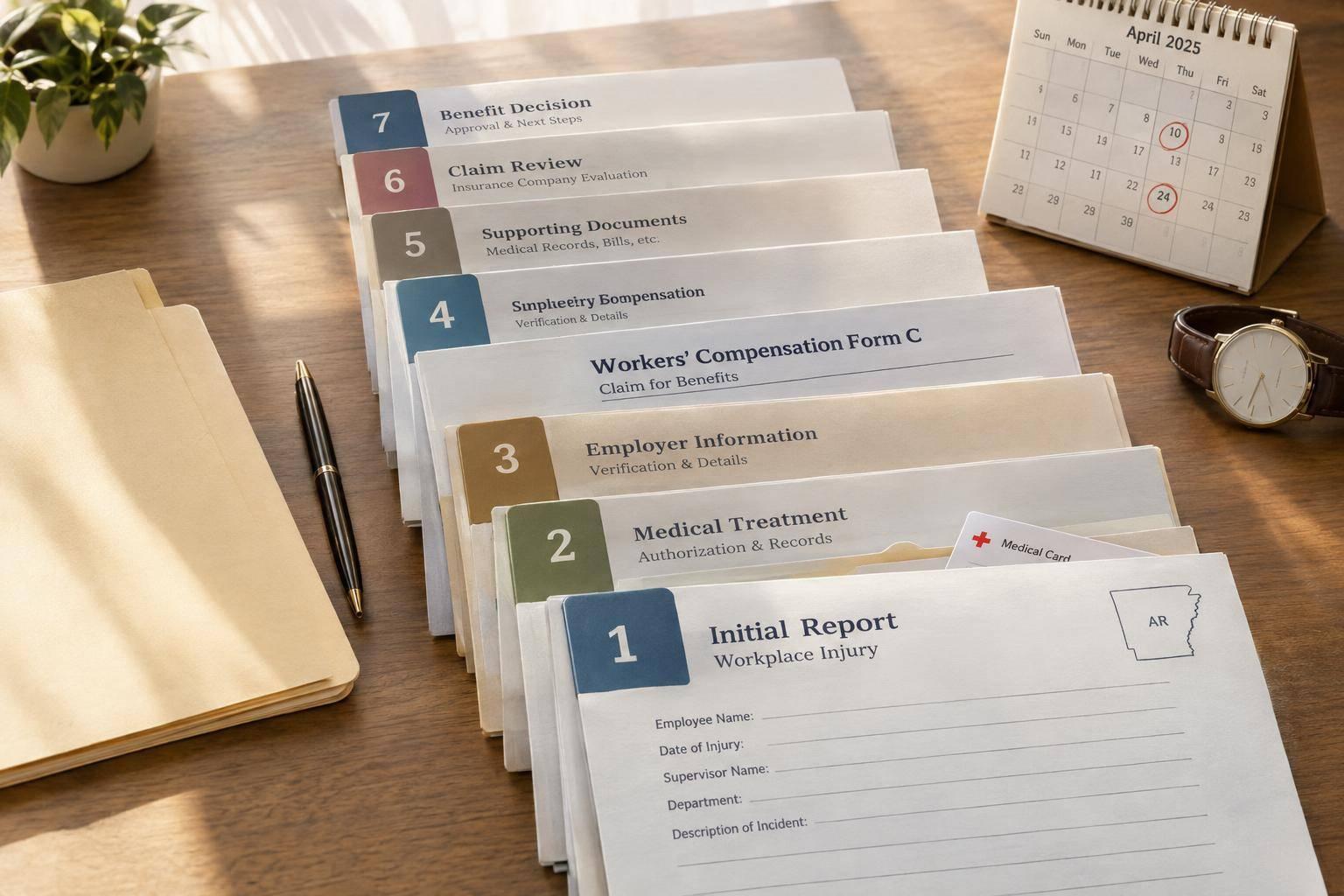
Reporting a work injury isn’t the same as filing a claim. I recommend getting care promptly, keeping written records, and confirming that your claim reaches the Arkansas Workers’ Compensation Commission. Most Arkansas injury claims have a 2-year filing deadline, though exceptions apply.
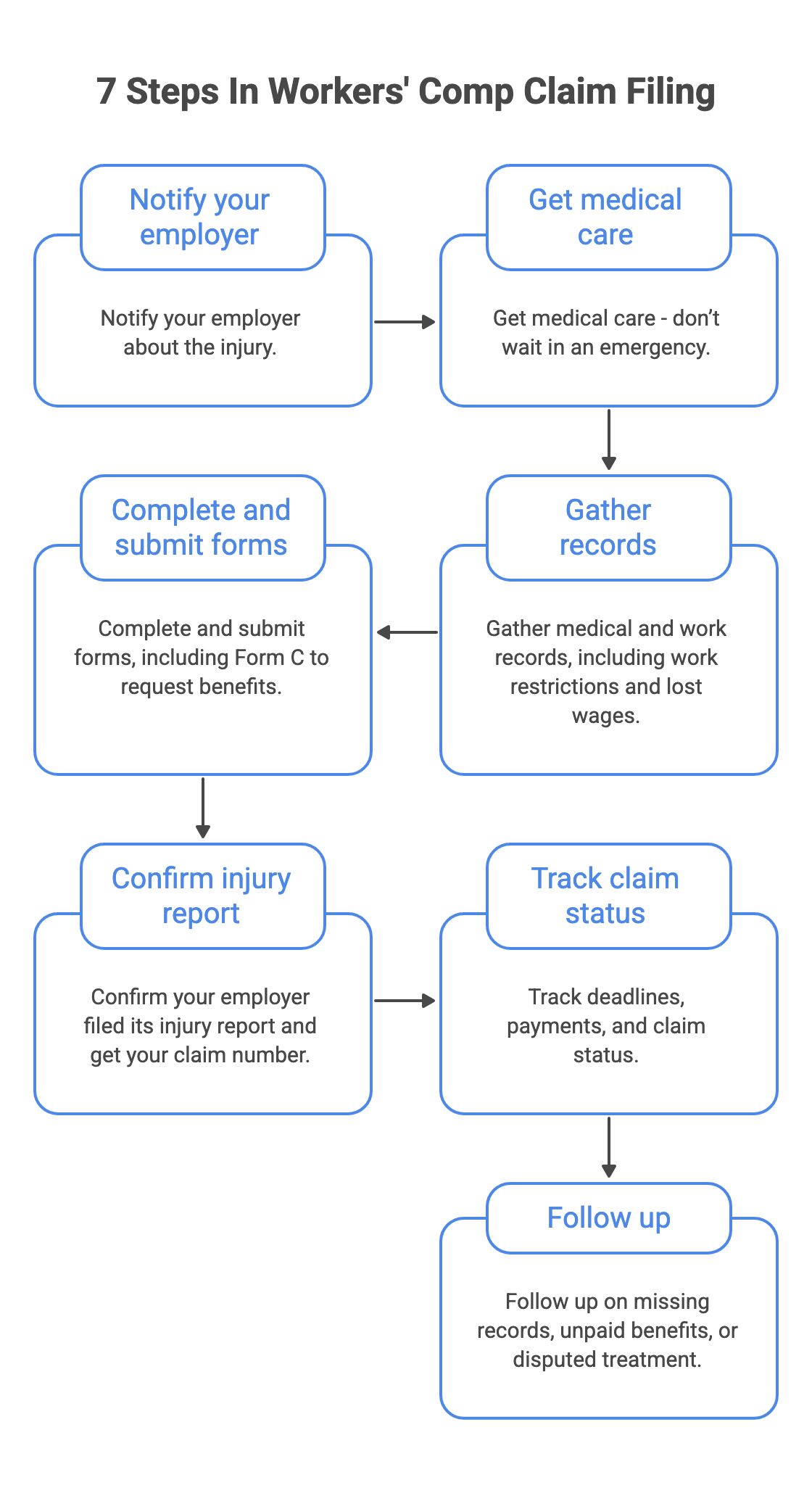
Here are the seven steps I’ll walk you through:
- Notify your employer about the injury.
- Get medical care - don’t wait in an emergency.
- Gather medical and work records, including work restrictions and lost wages.
- Complete and submit forms, including Form C to request benefits.
- Confirm your employer filed its injury report and get your claim number.
- Track deadlines, payments, and claim status.
- Follow up on missing records, unpaid benefits, or disputed treatment.
My advice: keep proof of every filing. An employer’s report or an adjuster’s phone call does not replace filing with the Commission. For business owners, an insurance agent can help with reporting questions; unresolved disputes may call for legal advice.
Step 1: Notify Your Employer of the Injury
Tell your employer or supervisor about the injury as soon as possible. If you need emergency care, get treatment first, then notify them by the next regular business day.
Write down the date, time, place, and cause of the injury, along with what you were doing and which body parts were hurt. Include each witness’s name and contact information so they can be reached later if needed.
Complete and sign Arkansas Form N, Notice to Employer/Employee. Keep a signed copy for your records to start the paper trail for your claim.
After giving notice, get medical care and keep every treatment record.
sbb-itb-b725090
Step 2: Get Medical Care
After notifying your employer, get medical care promptly and tell the provider your injury happened at work. Explain when, where, and how it happened. Name your employer, describe the task you were doing, and report your symptoms accurately. Ask the provider to document the connection to your work.
For a life-threatening emergency, call 911 or go to the nearest emergency room. Don’t wait for claim forms or approval. Save your treatment details for the records you’ll gather next.
For nonemergency care, ask your employer or claims administrator for the approved doctor’s contact information before scheduling. Arkansas employers generally choose the initial treating physician.Your regular doctor may not be approved for that first visit. If you get nonemergency treatment without approval, you may have to pay for it yourself.
To change doctors, request approval in writing. The employer or carrier should respond within five business days.If your request is denied, ask the Arkansas Workers’ Compensation Commission about its one-time change-of-physician process and eligibility rules.
Save all visit summaries, discharge instructions, bills, and receipts for Step 3.
Get your work restrictions in writing, including lifting limits, movement limits, required breaks, and your next review date. Send a copy to your employer and claims administrator promptly. If your employer offers light duty, ask for the assignment in writing so you can check that it fits your medical limits. In Step 3, you’ll gather these records to have them ready when you complete the claim forms.
Step 3: Collect Medical and Work Records
Keep everything in one claim file. Start with the medical notes and work restrictions from Step 2. Gather and sort all injury-related records: medical notes, test results, prescription receipts, work restrictions, wage records, attendance records, and the incident report. Add emails, texts, and call notes, too.
Request any missing records. If the carrier asks for earlier treatment records, specify the provider, date range, and exact documents needed. Martin Agency can help commercial policyholders confirm claim contacts and the carrier’s secure submission method. Confirm that method before sending sensitive information.
Keep a dated timeline of symptoms, appointments, missed shifts, and communications. For each call, note who you spoke with, what they requested, and the next step. Have the file ready when you complete the claim forms in Step 4 so you don’t miss any details.
Step 4: Complete and Submit Claim Forms
Use your records from Step 3 to fill out the forms, including the injury date, affected body parts, and treatment dates. Form N notifies your employer of the injury. Form C formally requests workers’ compensation benefits. Neither replaces the employer injury report.
File Form C to request benefits, especially if they’re denied, delayed, or disputed. Submitting Form N does not mean you’ve filed a claim.
Before signing, check your employee information, employer details, injury date and description, affected body parts, treatment information, and dates of missed work. Fix any errors before submitting. Keep a copy of each signed form, along with any receipt or email confirmation that shows when you submitted it.
Next, confirm that your employer filed its injury report.
Step 5: Confirm Your Employer’s Injury Report
After filing your own forms, check that your employer’s injury report matches your records.
In Arkansas, employers generally file Form 1, the First Report of Injury or Illness, for claims involving lost time, indemnity payments, or a disputed claim. They generally have 10 days to report, starting from whichever happened later: the date lost time began or the date they received notice of the injury.
Ask who filed Form 1 and request a copy or written confirmation. Get the adjuster’s name, phone number, email, and claim number.
Compare the report with your records. Check the injury date, affected body parts, missed-work dates, injury description, and notice date. Send corrections to both the employer and adjuster in writing, and keep proof of delivery.
Your employer’s report does not mean your claim has been accepted. It also does not replace the employee claim forms you’re required to file.
Keep your records current. Confirm that the employer, insurance carrier, or third-party administrator (TPA) has the correct report and claim contact details.
If your employer won’t confirm that it filed the report, ask for an answer in writing. Contact the carrier, TPA, or Arkansas Workers’ Compensation Commission for guidance. Continue documenting the missing confirmation until you have the claim number and adjuster’s contact information.
Once you confirm the report, move to Step 6 to track deadlines and claim status.
Step 6: Track Claim Deadlines and Status
Use the claim number and adjuster contact information from Step 5 to track your deadlines. In your existing claim file, record each date separately: your injury notice, the employer’s report, the insurer’s response, your claim filing, and any deadline for additional compensation. The first payment is generally due 15 days after the employer gets notice, then every 2 weeks unless the Commission sets another schedule. Check how these dates apply to your claim, especially if benefits are disputed.
For most Arkansas injury claims, you generally have 2 years from the date of injury to file an initial claim. Notifying a supervisor, getting medical care, completing an accident form, or calling an adjuster does not count as filing with the Commission. File early and keep proof that the Commission received your claim.
Once you’ve protected the initial filing deadline, check the deadline for additional compensation. If compensation has already been paid, that claim is generally due by the later of 1 year after the last compensation payment or 2 years after the injury. Your request should clearly ask for additional compensation. Track payment dates and authorized treatment dates, too: medically necessary treatment may count as compensation when calculating the filing deadline.
Keep a log of every submission, including the recipient, delivery method, tracking number, claim number, and adjuster contact. Record requests, appointments, work restrictions, payments, and unpaid bills. Set a follow-up date for each pending document, treatment request, or payment. Ask the adjuster what they received, what’s missing, and who handles the next step.
Calls alone don’t prove filing. Confirm important calls in writing, and keep receipts or stamped copies showing delivery to the correct office. Sending documents to an insurer does not always count as filing with the Commission. A delayed response does not extend the deadline.
If your claim stalls, Step 7 covers how to follow up.
Step 7: Follow Up on Your Claim
After filing, keep your claim active by responding promptly to requests and reporting changes in your symptoms, treatment, or work status. Provide requested records, wage information, statements, or medical exams without delay.
Document missed payments, denied treatment, and inaccurate records in writing. Explain the problem, ask for a correction, and keep copies of your request and the written response. No response does not mean approval.
Contact the Arkansas Workers’ Compensation Commission (AWCC) for procedural help with filing questions or claim status. If a dispute remains unresolved or you face an appeal deadline, seek legal advice. Agency assistance does not replace legal advice.
Business owners can also contact their insurance representative with questions about where to send a claim.
Martin Agency’s Role for Business Owners
Martin Agency can help commercial policyholders with coverage questions and claim-reporting logistics. It does not decide benefits or provide legal advice.
Conclusion: Keep Records and Confirm Next Steps
Check that you’ve completed all 7 steps, and store all claim documents in one file.
Ask your agent or adjuster to confirm the claim status, any missing items, and the next deadline in writing. Business owners should review their coverage and reporting duties before an injury occurs. Martin Agency can help with coverage questions and claim-reporting logistics.
After filing the claim, keep your records up to date and get written confirmation of each next step.
FAQs
Can I file an Arkansas workers’ comp claim without my employer’s help?
Yes. You can file a workers’ compensation claim without your employer’s involvement. If you’re unsure about your rights or obligations, contact the Arkansas Workers’ Compensation Commission for clarification.
If you’re a Martin Agency client, their team can guide you through the claims process, explain your policy, and help you gather the required documents. They can also serve as a liaison to help ensure your claim is handled correctly.
What if my work injury develops gradually?
Record when your symptoms started, and notify your employer as soon as you’re aware of the condition. Keep a detailed timeline of how your injury has progressed. Workers’ compensation claims require clear records.
If you need help filing a claim or understanding how your policy covers gradual injuries, Martin Agency can offer personalized guidance and help with your claim submissions.
Can I receive benefits while working light duty?
You may still receive benefits while working light duty. It depends on your claim and how your light-duty pay compares with your pre-injury earnings. If you earn less than you did in your previous role, you may qualify for partial disability benefits to help cover the lost wages.
For guidance on how your situation affects your benefits, contact the team at Martin Agency at 870-892-5222.