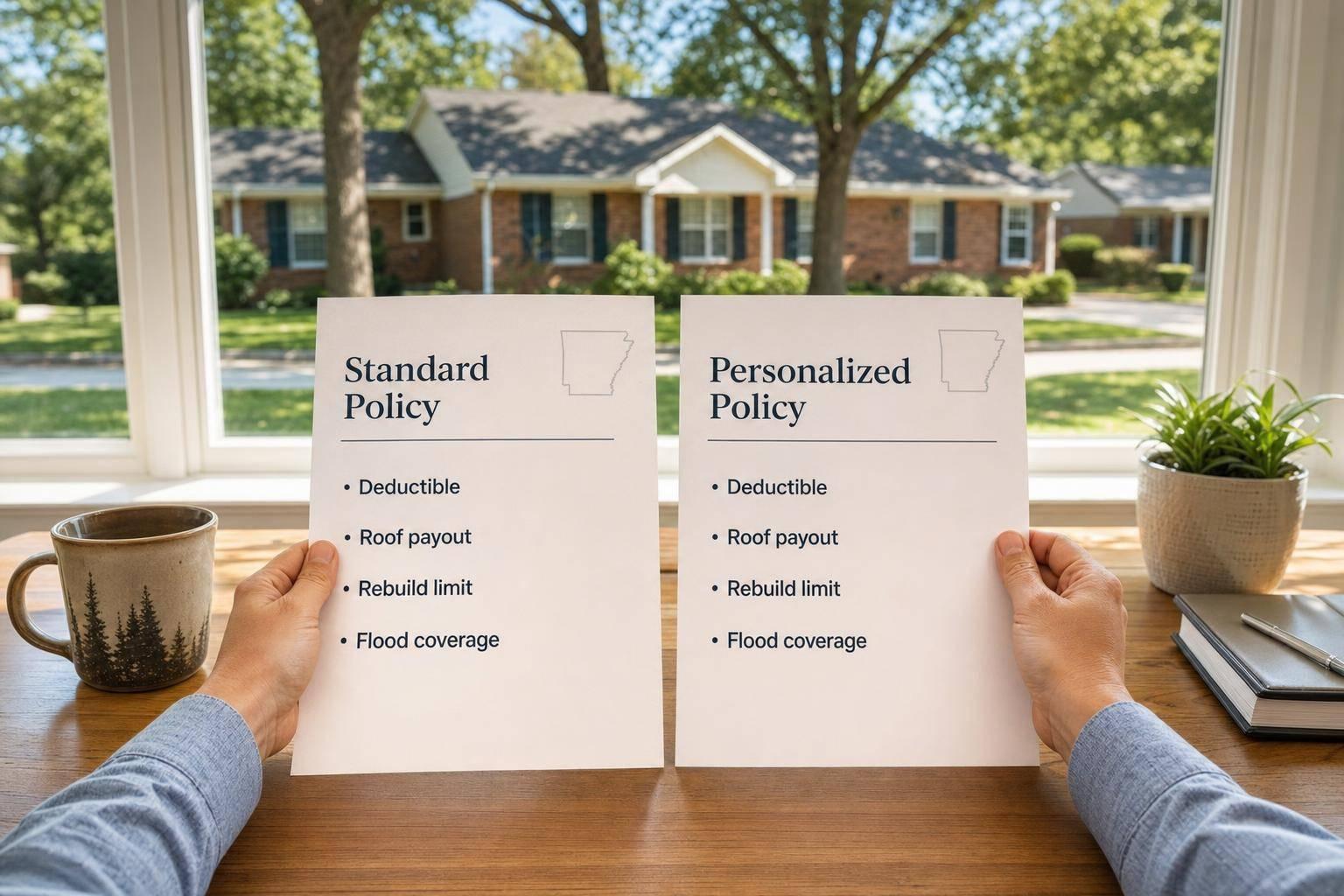
For many Arkansas homeowners, the better policy is the one that fits storm risk, roof terms, deductibles, and rebuild cost - not just the one with the lowest price. In a market where 2023 losses hit about 144% and 2024 premiums climbed 15% to 20%, I’d look past the monthly bill and check what the policy may leave me paying after a claim.
If I were comparing these two options, I’d focus on four things first:
- Coverage fit: Does the dwelling limit match what it would cost to rebuild?
- Deductibles: Is it a flat $1,000 or $2,500, or a 2% wind/hail deductible tied to home value?
- Roof terms: Is the roof paid at replacement cost or actual cash value (ACV)?
- Gaps in coverage: Do I need add-ons for water backup, jewelry, firearms, barns, sheds, or flood insurance?
Standard insurance is often a simpler fit for homes that match normal underwriting rules. Personalized insurance makes more sense when the home has outbuildings, higher rebuild costs, storm exposure, or other risks that don’t fit a basic setup. And if a home lands in the surplus-lines market, it’s worth knowing those policies are not backed by the Arkansas guaranty fund.
Quick Comparison
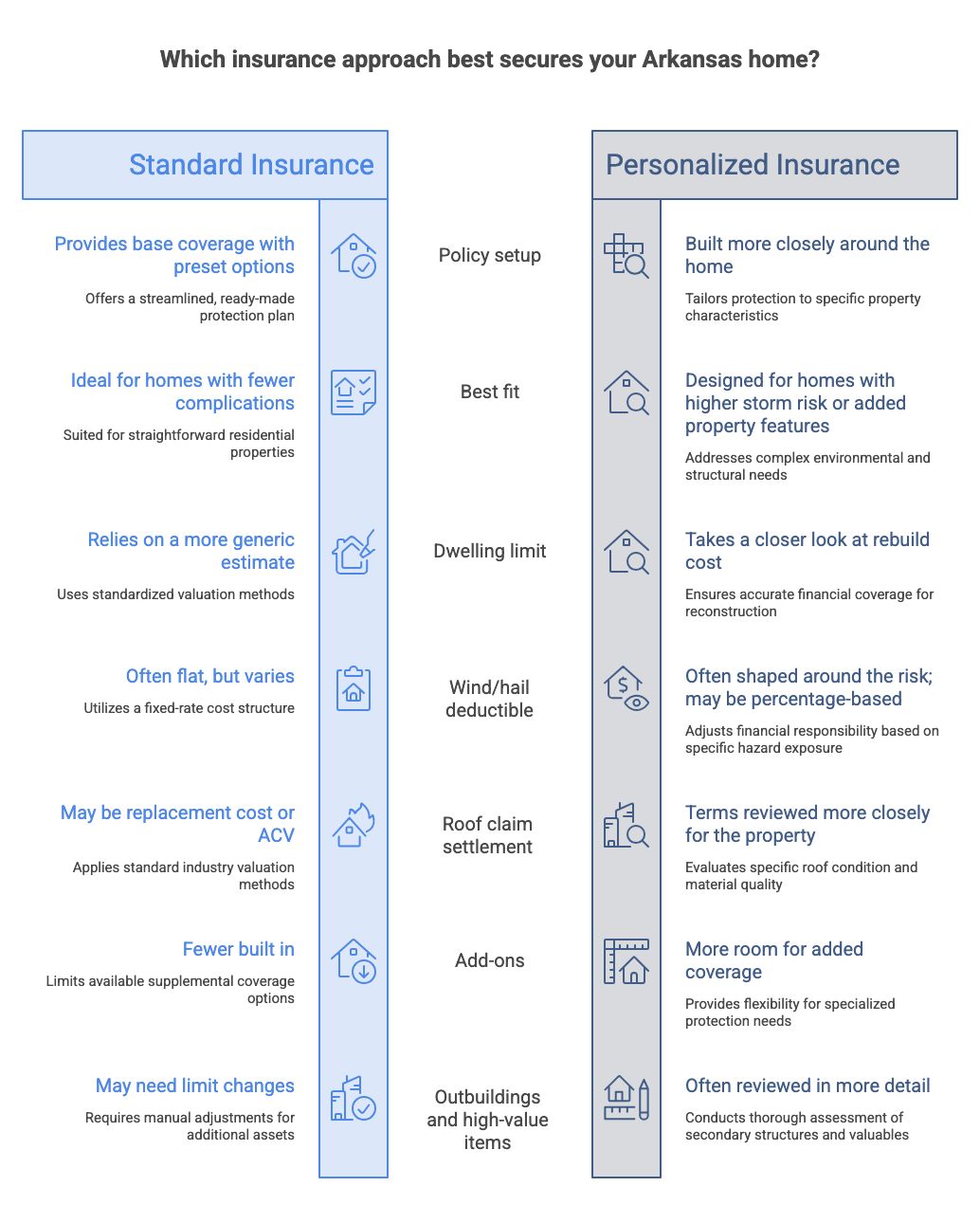
Bottom line: if I owned a standard home and wanted simple coverage, a standard policy might be enough. If I owned a rural home in Arkansas, had a barn or shop, faced hail risk, or wanted tighter control over claim terms, I’d lean toward personalized coverage.
sbb-itb-b725090
Standard vs Personalized Coverage: The Basics
Both types of coverage handle the same core areas: dwelling, personal property, liability, and loss of use. The big difference is how closely the policy fits the home itself.
Standard Home Insurance for Arkansas Homes
Standard policies rely on preset coverage parts and general assumptions. For many Arkansas homes, that setup is simple and easy to follow. It gives homeowners a familiar starting point.
The problem starts when a home doesn’t fit that standard mold. Rebuild costs, detached structures, higher-value belongings, and local storm risk may go beyond what a standard policy includes by default. That matters in Arkansas, where tornadoes and hail lead to heavy losses according the Arkansas FAIR Plan. A policy can look fine on paper, then fall short when replacement cost or storm exposure goes beyond those preset assumptions.
Personalized Home Insurance for Arkansas Homes
Personalized coverage is built more closely around the home’s rebuild cost, the features that affect that cost, and the homeowner’s actual liability exposure and property value. For rural Arkansas homes with outbuildings, equipment, or limited fire access, that kind of fit can help avoid underinsurance after a loss.
Some homes that don’t fit standard underwriting end up in the surplus-lines market, where terms may be less flexible and costs may be higher. That’s where tailoring can matter most, especially when limits, deductibles, and endorsements need to match the property instead of forcing the property to fit the policy.
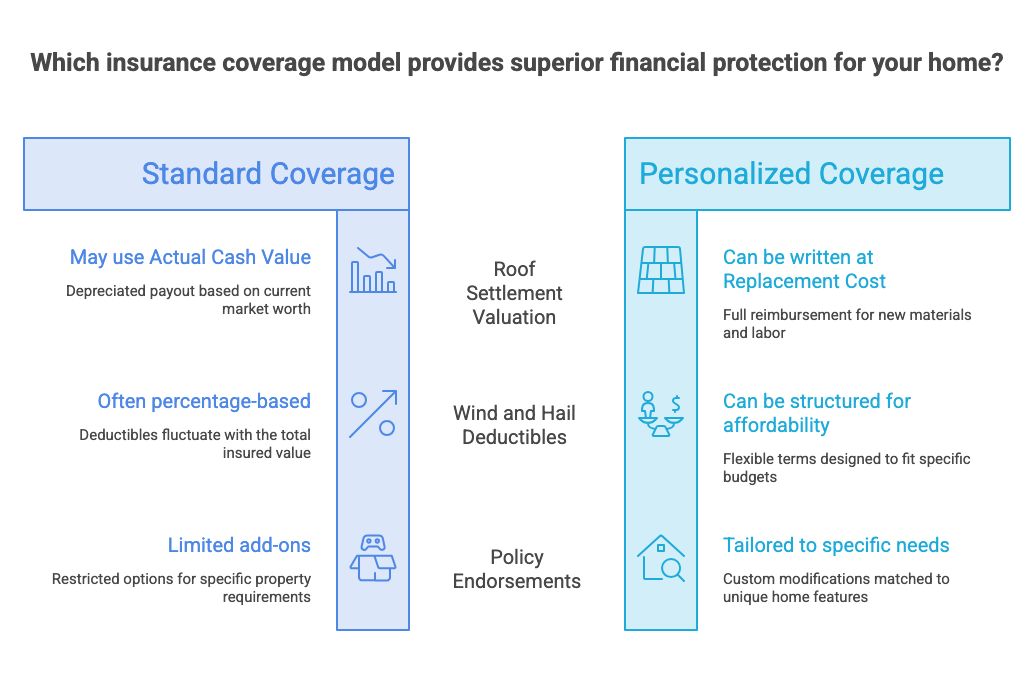
The clearest way to see the difference is in how each policy is built.
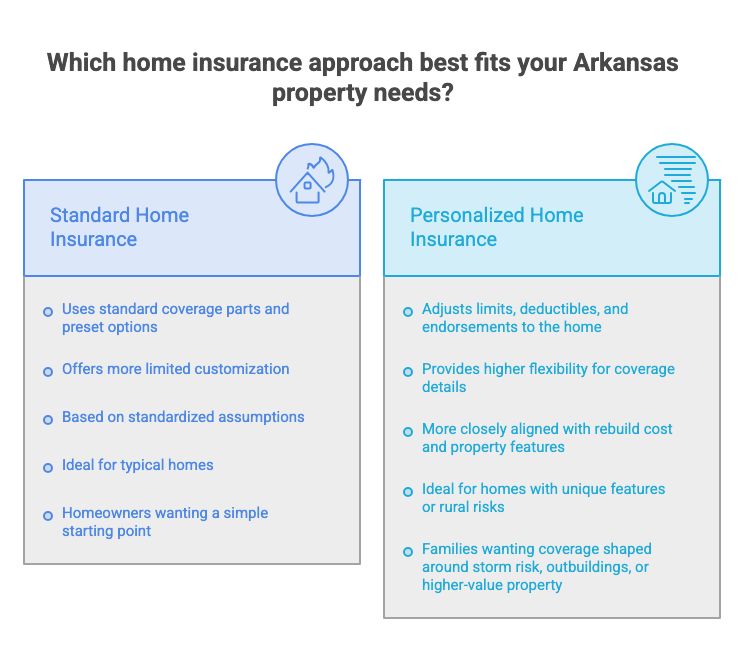
Coverage fit becomes more important once you start looking at limits, deductibles, and endorsements.
Coverage Fit, Deductibles, and Endorsements
Once the policy type is set, the next step is simple: do the details fit the home you actually have?
Matching Coverage Limits to the Home
Standard dwelling limits don't always line up with custom builds or detached structures like shops and barns. If the home is a total loss and the dwelling limit doesn't match local rebuild costs, the homeowner pays the difference out of pocket.
That's why it helps to set limits based on the home itself, not a generic estimate. Recent photos and exact square footage at the time the policy is written can help the insurer track rebuild cost more closely, especially for homes with outbuildings or custom features.
When limits come in too low, homeowners usually don't feel it until after a loss.
Deductible Options and Wind or Hail Exposure
Standard policies often use a flat deductible, usually $1,000 or $2,500, for most claims. But personalized or surplus-lines policies in Arkansas often treat wind and hail differently. Instead of a flat amount, they may use a deductible based on a percentage of the dwelling value.
That can cut the premium, but it also means higher out-of-pocket costs after a storm. For example, a 2% wind and hail deductible means the homeowner must pay 2% of the dwelling limit before the insurer pays anything. In a state that saw about $489 million in insured losses from the March 2023 tornado outbreak, that number needs to be clear before storm season.
This is where the fine print stops being "fine." It turns into a bill.
That matters most in Arkansas storm season.
Endorsements That Fill Common Coverage Gaps
A standard base policy often leaves out a few items that many homeowners assume are already covered. Water backup coverage, scheduled personal property for jewelry or firearms, and roof settlement terms are some of the most common examples.
Roof settlement terms matter a lot in Arkansas. More carriers are using Actual Cash Value (ACV) for roofs, which means depreciation gets deducted from the claim. In plain English, the roof may be covered, but the payout can be a lot less than expected.
Flood coverage is separate from homeowners insurance in Arkansas.
The table below sums up the main gaps.
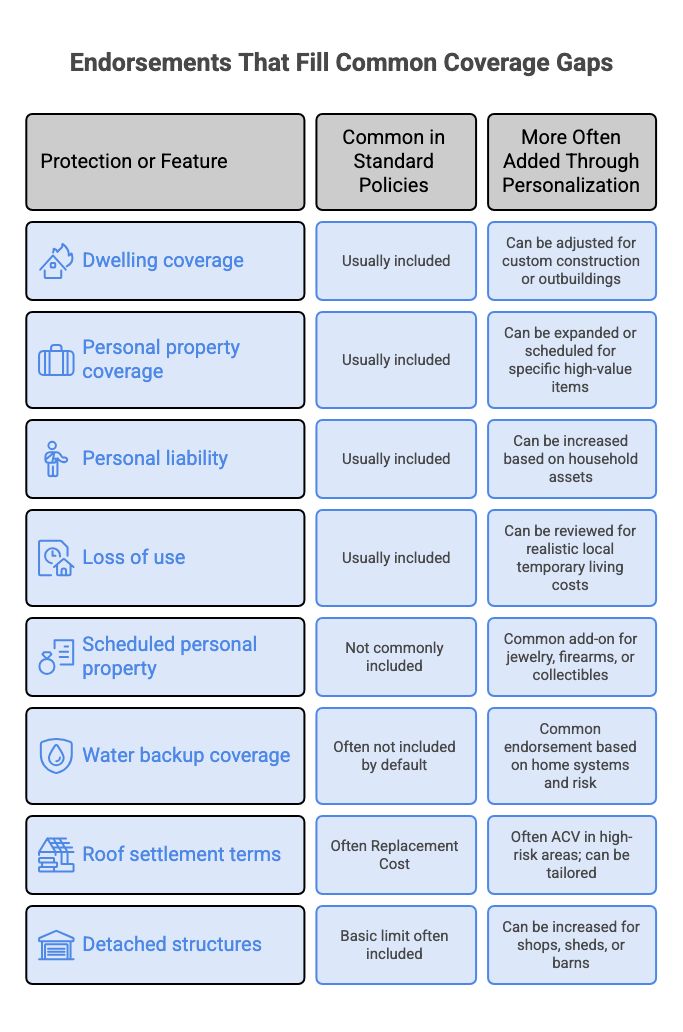
For Arkansas families with higher-value belongings or outbuildings, these add-ons can make the policy line up much more closely with the loss they might face.
These choices matter most when Arkansas weather turns severe.
Arkansas Weather Risks and Claim Support
These coverage choices matter most when Arkansas storms roll in. Roof terms, deductibles, and flood coverage can change what a family ends up paying out of pocket after a loss.
How Storm Risk Affects Coverage Decisions
Some Arkansas homeowners policies settle roof claims on an Actual Cash Value basis. That can shrink the payout after hail or wind damage because depreciation gets taken out.
Flooding can also show up in small, local areas after heavy storm rain, even if the home isn't near a river. That catches a lot of people off guard. Homeowners insurance in Arkansas does not cover flood damage, so families need separate flood insurance through the NFIP or a private flood insurer.
Once the storm clears, the fine print in the claim often matters just as much as the damage itself.
Why Claim Support Matters After Storm Losses
After a major storm, the claim outcome often comes down to two things: the deductible structure and the roof settlement terms. A local agent such as Martin Agency can help explain what the policy says and help organize the claim.
That protection does not apply to surplus-lines policies.
The next issue is whether that added help is worth the extra cost over time.
Long-Term Cost Tradeoffs and the Right Fit for Arkansas Families
Once the coverage terms are set, the next step is simple: Will the policy still hold up when you file a claim? That’s where the long-term cost picture gets a lot clearer.
Arkansas had the second-highest homeowners loss ratio in the U.S. in 2023, with insurers paying about $1.44 in claims for every $1.00 collected in premiums. That kind of pressure has led many carriers to tighten approval rules and trim coverage terms. So the part that stings isn’t always the renewal bill. It often shows up when damage happens and the claim is settled.
When Standard Coverage May Be Enough
For a home with standard construction and an owner who’s fine with baseline protection, a simple policy can make sense over time. If the policy uses a flat-dollar deductible and pays roof claims on a replacement cost basis, it may cover many common losses without a big out-of-pocket shock.
When Personalized Coverage Often Delivers Better Value
Homes with older roofs, higher rebuild costs, or steady wind and hail risk bring more exposure than a basic policy may be set up to handle. In those cases, personalized coverage can do more of the heavy lifting. It can shape the deductible in a way that fits the household budget, add endorsements like water backup, and confirm whether the roof is settled at replacement cost or actual cash value.
The biggest long-term cost gaps usually come from three places:
- Roof claims
- Deductibles
- Add-ons
A local agent can walk through how those details change what you may pay after a loss. Martin Agency, a family-owned independent agency in Pocahontas, offers that kind of guidance for Arkansas homeowners.
Conclusion: Focus on Coverage Fit, Not Just Price
Standard coverage can work for simpler risks. Personalized coverage tends to make more sense when storm exposure, rebuild cost, or deductibles leave a clear gap. The better choice is usually the one that does more to limit out-of-pocket costs, not just the one with the lower premium.
FAQs
How do I know if my home needs personalized coverage?
Your home may need personalized coverage if a standard policy doesn’t fully account for its risks or what’s on the property.
That can include high-value items, special structures like barns or poultry houses, or location-based risks such as flood zones or severe weather.
Your day-to-day life matters too. If you host events often or run a business from home, a local agent at Martin Agency can help spot possible coverage gaps.
What does a 2% wind or hail deductible cost me?
A 2% wind or hail deductible is tied to your home’s insured dwelling value, not a set dollar amount. So if your home is insured for $500,000, a 2% deductible means you’d pay $10,000 out of pocket before your coverage kicks in.
That can be a big bill after a storm. It’s smart to check your policy now, so you know exactly what you’d be on the hook for if wind or hail damage happens.
Should I add flood or water backup coverage?
Yes, it often is, especially for flood coverage.
Most standard homeowners policies in Arkansas do not cover flood damage. And that catches a lot of people off guard. Flooding isn't just a problem in high-risk zones either. In fact, more than 20% of flood claims come from moderate- to low-risk areas.
Flood insurance through the National Flood Insurance Program can help cover both the structure of your home and what’s inside it. Coverage is available for up to $250,000 for the building and up to $100,000 for contents. One thing to know: these policies usually come with a 30-day waiting period before coverage starts.
Martin Agency can help review your property’s exposure.